Episode Transcript
[00:00:01] Speaker A: Porto vallabh.
[00:00:12] Speaker B: Welcome to our Futurehood. A series of shows and podcasts about how we can work together to create a greener future.
It's part of the Mayor of London's Future Neighbourhoods 2030 program.
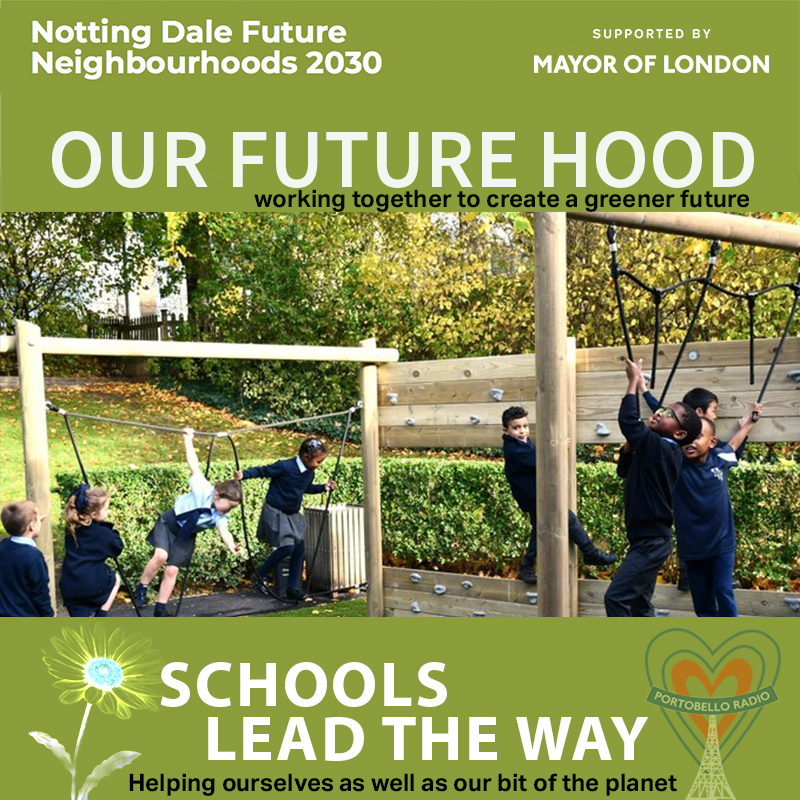
In the process, we'll be helping ourselves as well as our bit of the planet. The title of this episode is Schools Lead the Way.
How are they doing that? We talked some real experts.
[00:00:38] Speaker C: Well, our school has solar panels and green screens and heat pumps. Well, they've grown a lot of plants to help with oxygen, so it's easier to breathe.
They're all linked in the fact that they take natural energy and natural resources and create energy so it doesn't pollute the environment. The solar panels, they take in the sun and make it into electricity. Fossil fuels pollute the earth, but then heat pumps just generate hot water and turn it into electricity.
And the green screen, it protects our school's environment from becoming polluted.
[00:01:25] Speaker B: Those are the voices of pupils at Thomas Jones Primary School. I came down to the school in the heart of Nottingdale to see what the grown ups had to say. We're here at Thomas Jones Primary School to hear how local schools are leading the way on climate action, cutting emissions, improving air quality and inspiring young people to care for the planet.
Through Future Neighbourhoods 2030 program, schools are tackling climate change head on, from solar energy, flood prevention to greening and clean air projects. And we've got some experts with us today.
I'm delighted to have the headmaster of Thomas Jones, David Sellens. Welcome, David.
[00:02:05] Speaker D: Thank you, Piers. Thank you. It's absolute pleasure.
[00:02:08] Speaker B: We have a neighboring school, Avondale, the head pastor there, Ben McMullen. Welcome.
[00:02:14] Speaker E: Good to be here. Thank you very much.
[00:02:16] Speaker B: And we have the lead counsellor for education and children's services, Catherine. Catherine Faulks. Welcome.
[00:02:22] Speaker A: It's a pleasure to be here. Thank you.
[00:02:24] Speaker B: And we have the lead officer on climate change in the. In the borough, Anka, Georgia. Welcome.
[00:02:32] Speaker F: Thank you very much. Thank you for having me do your school.
[00:02:35] Speaker B: Well, let's start with you, David. Your school that we're sitting in here, gorgeous, you have been really leading the way on climate change and it started with infrastructure.
[00:02:46] Speaker D: Yeah. I mean, the school takes Mother Nature and all things pertaining to Mother Nature very seriously.
But there's only so much that we could do without the support of Ankur and her team.
Some of the very ambitious projects that were mooted right from the start, we were very keen to embrace that opportunity.
Some of them, you know, particularly things like the screening project where we've managed to have, have two very, very large areas closed off with climbing ivy. It's been hugely successful and cost effective and of course ultimately has played a massive part in reducing pollution because we're.
[00:03:30] Speaker B: Not that close, we're not that far from the west way, are we? So it's quite important here.
[00:03:35] Speaker D: We're 200 meters from the west way and we know the west way is, is a big challenge in regard to pollution.
Sometimes it actually feels like an authentic oasis when you are here.
Somebody said to me just the other day, my goodness me, it's the autumn, it's not even high summer and it feels like we're walking in a park.
I think that's a huge achievement given where we are geographically located.
[00:04:01] Speaker B: Absolutely.
Ben Avondale, which is an older school than this one, you've also undertaken quite a lot of structural work.
[00:04:13] Speaker E: Yeah, we've been very grateful to have had the offer of taking a school building which is more than 100 years old and tried to bring it into what the modern era requires of a multi use building.
It's a classic school building built for a different era.
But the air source heat pump program project has allowed a complete retrofit of the way in which the school's heated, including the emitters. So every radiator and all the pipe work was also replaced in the same project. And now we are completely non dependent on gas as a heating source, which to my mind as a, as a head teacher feels very reassuring that we're not dependent on gas and fossil fuels in the same way as we would have been, but also that it saves the school money in the longer term that the heating is more efficient. And I think as a school and a primary school in particular, we need to lead on that.
It's a great thing for the children to be aware of that not only are they doing their bit, they're putting their paper in the recycling bin or they're taking an environmental method of getting to school. For example, they're doing their small part, but the entire building they spend six and a half, seven hours a day in also represents those high expectations and standards. So they can, they can hear the messaging but they can see it in, in real life around them every day in the, in the environment they spend their day in.
[00:05:39] Speaker B: And solar panels has been the other key plank of the structural changes.
[00:05:44] Speaker D: I knew very little about solar panels before they actually arrived and the team that came, it's like it comes all as a flat pack and literally within hours they were all installed and functioning and working.
It's the Future, I think, and certainly I just wish we had better weather sometimes, but.
But we have in recent years. The summer months have been very kind, haven't they? And certainly we've benefited from that.
[00:06:12] Speaker B: And have you seen a marked decrease in the bills as a result, or at least not a massive increase?
[00:06:20] Speaker D: It's been negligible.
But I think that, you know, it's too. It's too early in the project, really, to sort of to make a decision that it's either something's going to be a big saver or otherwise. I think if you ask us that question again in perhaps two years time, I'd better give you a better answer. But I'm optimistic. I'm a great optimist, full stop.
I think we need to continue to use those panels and to monitor expenditure and to see in real terms whether actually it's going to afford a huge saving or not, as the case may be.
[00:07:00] Speaker B: Catherine, why did council see schools as being at the forefront of all these changes of greening the borough?
[00:07:07] Speaker F: Thank you.
[00:07:07] Speaker A: Well, I think, number one, we think greening all the council properties was one of the commitments we made to net zero by 2030. But schools in particular we wanted to start with, because actually, as Ben and David have said, for children, you know, it's the very important messaging that we're giving them that we think, you know, climate change is a thing, but we can put things in place to help mitigate that. So, as you say, with the air source, heat pumps, the solar panels insulating the windows is to help children recognize that, you know, they must sometimes feel a bit out of control and no one's doing anything, and that must make them very anxious. And we don't want the children to feel anxious. We want to say yes, you know, we can put things in place. We recognize this is a. Is a problem and we're here to support you through that. And as David has just said, there is some optimism. You know, it's not all hopeless. There are positive things that we can do around greening schools. So I'm really glad that we're working with the schools on this project and actually with the children, and that the children are learning from what we're doing with them.
[00:08:16] Speaker B: The structural improvements are obviously very important and both your schools suffered a little bit from flooding. And I know Ben at Avondale, the flooding was really quite intrusive, wasn't it, in terms of the workings of the.
[00:08:32] Speaker E: Building warmer and weirder weather is something that we've all got to mitigate against going forward. And so yeah, we were affected by flash flooding which filled the basement and destroyed the existing gas boiler as well as some other bits and pieces that were stored down there. But, you know, that was replaced by a temporary gas boiler and now we're onto an air source heat pump system. So, know, a silver lining to that particular rain cloud was that we've got, you know, a much greener future facing heating system. But, yeah, that took out the, the entire basement with the, with the, with the boiler in it. So it's been a big project and I think the outcome now is fantastic.
But we have to think about how do we prevent such a thing happening again and again. And we've got suds planters that tap into the downpipes, slowing the water runoff, reducing the sort of burden on the sewage system. And also those planters, you know, have got wonderful plant life in them. Children can see directly that the rainwater is being used through those. So it's got dual purpose there, really, and it's kind of a good emblem, really, on how we can channel increase rainfall into a positive, you know, outcome for the children that it can visibly see that plants are growing with the help of this water. And it's not the same water that's then going to cause damage to the school. There's been other structural mitigation to stop floodwater entering the basement again. So again, it's been prepared for the future, but also channeling it in a fruitful way.
[00:10:05] Speaker B: Were these improvements disruptive for us?
[00:10:09] Speaker D: No, it was very, very straightforward. It was very linear and quite educational, actually. Children found it really fascinating.
I think some of the children were quite keen to actually join in, become builders or structural engineers. Certainly had opinions about everything that was going on. They have opinions about most things, to be honest, which is, as I see it, is very positive, where we're actually sat for this, for this, for this podcast. This was flooded. This was flooded. 10cm of water, as was about half the school.
So the damage was considerable.
Local authority were incredibly efficient.
They were here the day after the damage was done.
You'll appreciate there was an awful lot of damage in regard to sewage, so it wasn't pleasant.
A lot of things that Ben's already referenced, like clever ideas, ways to make the landscaping of the school work in our favour better.
And, you know, it's very promising, the fact that the local authority are looking at new ways of actually interacting with Avondale park and with Thomas Jones and with some other local schools as well, to look at how when it happens again, and it will at some Point, no doubt the school will not be flooded. You know that Avondale's basement won't be flooded and Thomas Jones classrooms won't be flooded and so on. And I gather that there. There are noises that, you know, there's going to be some. Some work starting quite soon pertaining to looking at further. Further mechanisms that can be introduced to. To eradicate flash floods from having a catastrophic impact.
[00:11:58] Speaker B: Katherine, how do you coordinate that collaboration? Because we've got the schools, we've got the children, we've got the parents, we've got the governors, we've got the council, we've got other organisations, the Ofsteds and so on.
How do you work at the centre of all that?
[00:12:15] Speaker A: Well, I think it starts with the leadership team's willingness to commit to the net zero for our council of state. So it starts at the top and then obviously, through wonderful officers like Anchor, who help us actually do the coordination with the schools to actually deliver it, and of course, help raise some match funding and grants from government to match the 8 million that the council has invested in this. But I just wanted to pick up on a point that actually both Ben and David have made about the education of this, because of course, it works on so many different levels, on the sort of huge, sort of global level of climate change, the little bit bits that we can all individually do, but also on the sort of nature level of the greening and the gardens and the children seeing things grown, growing. And I know that children absolutely love nature.
[00:13:05] Speaker F: Bees.
[00:13:06] Speaker A: When you've got bees here, David, I bought a bee expert into Thomas Jones actually, to talk to the children about bees and they just. Their eyes are wide open, they're so engaged.
So I think, you know, I come back to that piece. It's about trying to be optimistic and it's about thinking about what adaptations as you're talking about flooding, what adaptations do we have to make now to look to the future? Because we're all going to have to make them and we're all going to have to slightly realise it won't remain the same. So it's thinking ahead. What can we put in place? What can we put in place to try just to keep a step ahead?
[00:13:40] Speaker B: Anka, you, as the lead on future neighbourhoods, you were charged with making all of this happen. How did you find working with the schools on all of this?
[00:13:52] Speaker F: Great question. I think this is one of my favorite projects for many reasons, but one thing I would say from the beginning is that these projects would have not happened unless we have the support from schools having Head teachers like Ben and David and Jagdeep from Colville, for example, being part of passionate about environment in the first place but also being keen to see things happen and change in their schools and being on, on board to work together. Because this is a collaboration. It's not the council doing things at the schools, it's actually working in partnership.
This has been great and actually brainstorming together.
I also want to emphasize that we wanted to create a holistic environmental program that just doesn't tackle one initiative. It's actually tackling things holistically from, from addressing air pollution in the area, addressing extreme weather events like flooding and overheating, looking at food growing initiatives, education programs, active travel. So it's actually looking how can we address the different environmental issues.
Of course these projects are challenging and we were fortunate enough to secure funding from different sources. Council has committed, as Catherine said, but also governmental funding, but also looking at how can we involve other local organizations. So we're working with a charity called Urban Wise doing an environmental summit and education work in schools. And one of the things we were all keen when we, when we saw the infrastructure happening is that how can we actually make it relevant for children for them to understand what's happening at their school? And one final thing is these projects are quite complex. Some of the infrastructure and technology is quite, quite new.
But it's also working together with the suppliers to find solutions. In some cases there are lots of lessons learned and you know, it's still a learning curve, but also working with the schools in terms of disruption. So we had to work during the weekends in some cases, or we had to. But the schools I would say have been fantastic in actually accommodating this.
[00:15:52] Speaker B: Both Anka and Catherine have mentioned some of the smaller interventions that have happened because it's not all about solar panels and heat pumps. There must be some things that you've done that are actually more obvious to the kids.
[00:16:08] Speaker D: I mean, the education side has been huge.
It surprises me still just how insightful, even quite young children are about this theme.
They're surrounded by it.
Some of them have older siblings who are quite knowledgeable and they've absorbed their knowledge and keen to discuss those matters. I think they perhaps feel it more powerfully than we do.
It is going to be, after all, the next chapter is going to be their chapter, their story.
They have some quite strong views, some of my, what I call our Year six scholars, our eldest pupils who are very capable, they're very forthright in their views, the single minded resolve to to ensure that their views are listened to about trying to make the world a better place, a greener world.
[00:17:02] Speaker B: And Ben, there have been projects from. We've mentioned beekeeping. I don't think you do that, Havendell. But food growing, extra bicycle racks, all these sort of smaller things.
They all contribute, don't they, to not only greening the school, but improving the atmosphere in the school?
[00:17:21] Speaker D: Yeah.
[00:17:22] Speaker E: And I think part of the whole project is about a sense of empowerment and sense of agency that children should have in their futures. Long after we're gone, they'll be the ones, you know, carrying this. And for them to see the full cycle of growing food and eating the food that they've grown and seeing that whole process. We're at risk in a very built up urban environment of the children being quite dislocated from environment as a broader conception. And I think this brings it back to them being part of that and then it being part of their daily lives. And you know, they live in different environments in their homes and where they live. And it might be a very built environment, very hard. And so at least the school environment provides greenery, nature and an interaction with that nature so they can feel part of it. It's their environment. We're facilitating that.
[00:18:11] Speaker C: At school I try not to waste things. So finish up your lunch, don't throw away too early.
We have lots of reuse stuff. We have a recycle bin. Well, at home I unplug the TV at night time and I plug all my electrical things and I turn off all the Internet so it's not powering overnight.
At school I would litter pick.
I want to look after the environment because I really love animals. And if pollution keeps on going, if like pollution and global warming is really harming animals, pollution is harming mostly the sea creatures because they are eating like plastic.
And global warming is harming them northern and far southern creatures from ice melting.
One thing that my school has done for the environment, to help the environment is that we've been recycling things and instead of buying new things, we would get and we could use things that we already have bought.
And also we have lots of trees and plants in all areas of the school.
Cars, they Release Lots of CO2 and harmful gases into the atmosphere which builds up to the ozone layer.
I get to school by walking, sometimes cycling.
I feel like cycling and walking is very good for the planet and it reduces more, less gas and it's better for the environment.
I think the one thing that I would do was maybe I would encourage more non Gas cars, and also to encourage people to use more natural electricity. Like, for example, if we used solar panels for natural electricity and power. I would try and plant more trees around the school so our animals would have more places to live. And I'd plant 20% of them would be fruit trees. And the fruit they grow we would put in the cafeteria for us to eat. Maybe we could add some compost bins to the school so that maybe the waste, such as fruits, we could compost them and help our plants and even green screens thrive.
I imagine that this school, we could build a school, but it's all made out of a recycled parts.
[00:20:48] Speaker B: David, that was a very impressive set of young people who obviously care passionately about the environment.
It's important to you as well, isn't is?
[00:21:00] Speaker D: Yeah. And thank you very much. They are impressive. I'm very, very proud of them.
I came here a long time ago and it was one of the very first things that the team and I decided, as Ben has already mentioned, a lot of the children that we serve in our communities, they live in quite overcrowded conditions. Most of them don't have a garden, and some of them don't have access to safe places to play.
So one of the very first things we set out to achieve was to afford an antidote to that by making our schools somewhere that's better, very attractive to be, somewhere very safe, but also somewhere very green.
And we've invested and invested and invested for the best part of 20 years to create a very green and welcoming environment that extends to some degree to the inside of the building, but it's mainly the outside, and we're very blessed with. You know, I remember first coming here and thinking, oh, this is going to be really hard work. This is a 1970s prefab building that was supposed to last for five minutes.
And here we are all these years later, and we have, very slowly, a little bit like buying an old property and then doing it up. We've done it up.
And it's very much everything from the sort of wood paneling to the solar panels on the roof and the greenery in the grounds. It's very much an evocation of what we originally set out to achieve somewhere really special for children living in the inner city to actually be.
[00:22:39] Speaker B: Ben, we heard there from the pupils how much the environment means to them, but they're also a way of carrying the message back home and to their parents.
They're quite good stormtroopers in the cause of the environment, aren't they?
[00:22:58] Speaker E: Yeah, it's Very true. And I think that, you know, they've got the most to lose here. They've got the most stake in this game.
And we need to create in them a sort of evangelical sense of this is their mission. It's going to be perhaps the greatest significant issue in their lives.
And this can be a fantastic conduit to spreading that message back within their families. And I think that is what we're creating. We're creating very tuned in, very environment, environmentally aware cohort of young people and giving them not only the awareness but also the sense that they can make a difference. And I think that, you know, when a proposition comes to someone like David or I, you know, this is a chance to make a difference. It's so much bigger than what we can do in our own personal lives within our own lifestyle choices. For example, if the whole school estate can be a greener environment, that's about as big an impact as we could possibly, possibly have an influence in.
But we've got, you know, hundreds of children within our sphere of influence and hopefully that influence is going to be a positive one for them to take outside of the school gates.
[00:24:01] Speaker B: Catherine, you must be delighted with the way things are working out up here in Nottingdale.
[00:24:07] Speaker A: Yeah, I'm absolutely thrilled. And it's wonderful to hear David and Ben talk with such enthusiasm as to how it has had such. Such positive response with the children. And I think you've both made the same point. You know, Kensington Chelsea is the smallest, tiniest borough. It's very urban. But we are lucky. We've got seven parks. So it's this sort of odd combination. We've got parks, we've got very urban buildings, but we've got these amazing schools who all seem to be committed to doing the garden, even if they haven't managed to do the whole retrofit yet in their schools. They're still still growing things, they're still trying to deliver school streets. They're still putting nature first in their education for children, which spends is empowering. They need to feel that they have got a stake in this game, which. Which I think they have. And as David said, they'll have very loud voices, I think, at coming to everyone, which. Which is important because I don't think we can neglect this. It's, you know, it's for all the future, for everything of great. Getting a bit grim. But I'm optimistic. I'm optimistic with them and with us. We're all working together. Some really positive things are going to happen.
[00:25:15] Speaker B: Ankur. Some amazing things have happened during the future Neighbourhoods program.
The schools is at the forefront of that.
How are we going to make sure that these improvements keep on coming, going into the future?
[00:25:29] Speaker F: Yeah, very good question. Yes, we have been supporting the schools through the Future Neighborhoods program through a number of initiatives. So installing heat pumps and replacing gold inefficient gas boilers, doing air quality and climate change audits and installing air quality monitors and bike hangers. Also working on food pro food growing programs, but also addressing extreme weather events like flooding. So we are fortunate enough to secure funding through the Future Neighborhoods, but also through council contribution and other governmental funds to install climate adaptation. So this is very important. And also looking at LED projects, but also, as I mentioned before, we're looking at this holistically and one of the things we want to do is to continue to do these projects. There are exciting projects on the pipeline like the Windows works happening at Avondale and Corporation Colville and a few other schools, but also as I mentioned, the climate adaptation and the greening projects and we secure funding for, for those as well to continue.
We're also looking at education work. So, and this is in the context of more requirements coming from the government. The schools will have to have climate adaptation plans in the future. So we feel that these, these schools that we have been working are ahead of the game. So it's great to actually be able to, to work with them in advance and secure funding. But also looking at the future as well, future neighbourhoods.
[00:27:00] Speaker B: The Mayor of London picked two wards, Nottingdale and Somerstown in Camden, to become exemplars. And certainly what we're seeing here seems to be exemplary. What's it feel like to be leading the way in adapting to climate change in schools, which is where we bring up the next generation?
[00:27:22] Speaker E: I mean, it feels like the right place to be. I think schools have got to lead on that.
You know, the influence you have within a school for the number of children within your cohort, it's hugely impactful. So I'm very grateful for the opportunity to, you know, if we're at the forefront of it, I'm very glad to be there and I hope that other schools can use it as a model to look at how two different types of school setting, in terms of age of the building, can both be brought into a much more forward facing and environmentally correct position. So I think that could be a good model for virtually every school estate, really.
[00:27:56] Speaker B: And David, it provides a kind of educational model as well because the children, as they see their schools improve and become less inefficient it's that they're learning. At the same time, I think they're.
[00:28:09] Speaker D: Very proud, very proud to be pioneers. I think they're really eager, they're keen, as you've seen earlier when you interviewed them, to share their views.
So I think, you know, I know it sounds quite fanciful, but I do really strongly believe that the opportunity that's been afforded has really been rather empowering.
[00:28:29] Speaker B: If I might ask all of you one last question, Katherine, if I may start with you.
What if you were, if you had one ambition going forward from here, what, what would that be?
[00:28:42] Speaker A: Crikey, that's one to throw at me. Where do I start? I mean, obviously my one ambition would be that we could get to a position in Kensington Chelsea. We could affect all the house, you know, we could have insulation, double glazed windows, solar panels, you know, but it's such a massive task when we've got so many old buildings here. So obviously we're starting small with the council estate, which actually, you know, is only, only 2% of all the buildings in the whole borough. So it's to encourage everyone else which these wonderful children, as representatives of what they've learned in the schools, will be going home. But, you know, it's expensive. But I think parents, they're hearing this, can do their little pieces with their recycling, with their food recycling, with planting and planters and sort of thinking about walking to school and not driving everywhere. So there are things that will feed back. So. So I think my one wish is that this is a movement that keeps going forward, gains momentum and we engage everybody in working towards the same objective.
[00:29:45] Speaker B: Ben?
[00:29:47] Speaker E: I think with a project like this, we're really looking in the long term and I think that this is sowing the right seeds.
We're quite literally sowing some seeds in terms of edible gardens and stuff, but in terms of sowing the seeds within the children's awareness of what their environment can be like and the role they can play. And I think we'll see that mature over the, you know, the years to come.
And hopefully that sends a bit of a ripple out for, you know, other, other school settings that are looking to get involved in doing something less and taking on opportunities to become more, more green as an environment and as a, an attitude. So I think the truth will be in the longer phase and seeing how that pans out over time. And it is necessarily something that requires a collaborative and really long distance view of things. And that's what we've benefited from here. With the cooperation of the local authority in these works, it's not something short term, it's not something piecemeal, it's a holistic long range approach. And I think we'll just see the fruits of that being born over time.
[00:30:49] Speaker B: Anchor someone who's been charged with making all this happen. What would your ambition be?
[00:30:54] Speaker F: I think the key has been partnership and I really believe in solidarity. So in the future for these projects to continue, it's very important to work together.
And it's not just the school, the council, it's also the parents, the governors, the children. And I really believe that another world is possible. And the children are showing us through, through the education work and the way they, they imagine their school, they imagine their neighborhood.
So the, the key message for me is that for these projects to continue in other schools and every time I'm asked in London to, to help other local authorities in putting projects like this happen in other schools is that we cannot do it without collaboration.
[00:31:37] Speaker B: David, thank you so much for hosting us. We had an amazing welcome from the pupils as we arrived.
You've obviously done amazing things so far.
What would be your next step? What would be your ambition?
[00:31:52] Speaker D: Everybody here in the room has really captured it, which is to not lose sight of what matters most. And I think it's very easy to do that.
Nobody is for a moment suggesting that the current climate is an easy one. It's a very difficult one out there, particularly for some people.
But this is huge. This is one of the single most important things.
I think the children at my school and the children at Avondale park, and I'm sure the children at all the other local schools, they understand that it's their future and we mustn't lose sight of how important that is. These kinds of projects, they play an important part.
I hope they continue to, to function. I hope they're funded well and that we can incorporate more schools into the wonderful projects that we have both benefited from over the last couple of years. Thank you.
[00:32:47] Speaker B: No, thank you. And thank you, everybody.
[00:32:50] Speaker E: Thank you.
[00:32:50] Speaker A: Thank you.
[00:32:51] Speaker D: Thank you.
[00:32:52] Speaker B: What's happening here shows how climate change can be practical, local and deeply educational.
By working together, we're creating greener, healthier learning environments for future generations.
It's inspiring to see how schools, the council, the community and local partners are working together to make a real difference, not just in buildings and infrastructure, but in how young people think about the planet and their role in protecting it.
[00:33:21] Speaker C: And if we don't look after the planet when we're older, it won't be as good and no one else is going to help with it. We are the next generation.
And if we didn't do it, if we didn't understand how to help the environment, then when it's our turn to take over, when it gets put into our hands, we may not know how to help our environment, our world.
Later in the future, all the adults will die. And then it's all our job to help the environment.
It's important because if we don't, who else will?
If children sit there and adults do the work, children won't know what to do when they grow up. So then the world will turn more polluted, the opposite of what we want.
Well, we're the next generation, so the adults are not going to be here when we're adults. So we need to look after the planet now, because it's our generation's planet. The children are the next generation. And when they have children, children would follow what their parents do. So if they saw their parents recycling or reusing some, the children would reuse or recycle with the next generation. And wherever we do, our children would have followed. We might be the problem to climate change and global warming, but we can also be the solution.
[00:34:54] Speaker B: Thanks for listening. My name is Piers Thompson. This is Portobello Radio, your local community radio station. And this series has been supported by the mayor of London. You can find all the previous episodes wherever you get your podcasts. Just search our future hood.
Goodbye. You are listening to Portobello Talk Radio.
[00:35:15] Speaker A: The authentic voice of Flatbrook Grove.