Episode Transcript
[00:00:02] Speaker A: You are listening to Portobello Talk Radio, the authentic voice of Letbrook Grove.
[00:00:09] Speaker B: Hello and welcome. My name is Akiya and I'll be your host for season two of our Futurehood. It's a series of podcasts set in Nottingdale about how we can work together to create a greener future as part of the Mayor of London's Future Neighbourhoods 2030 program.
In the process, we'll be helping ourselves as well as Albert of the Planet.
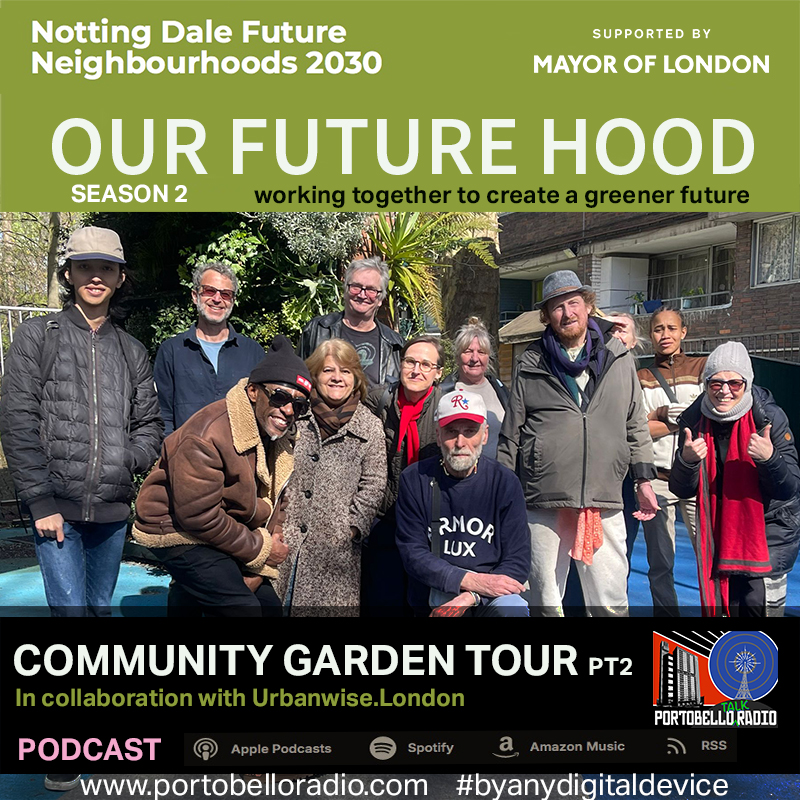
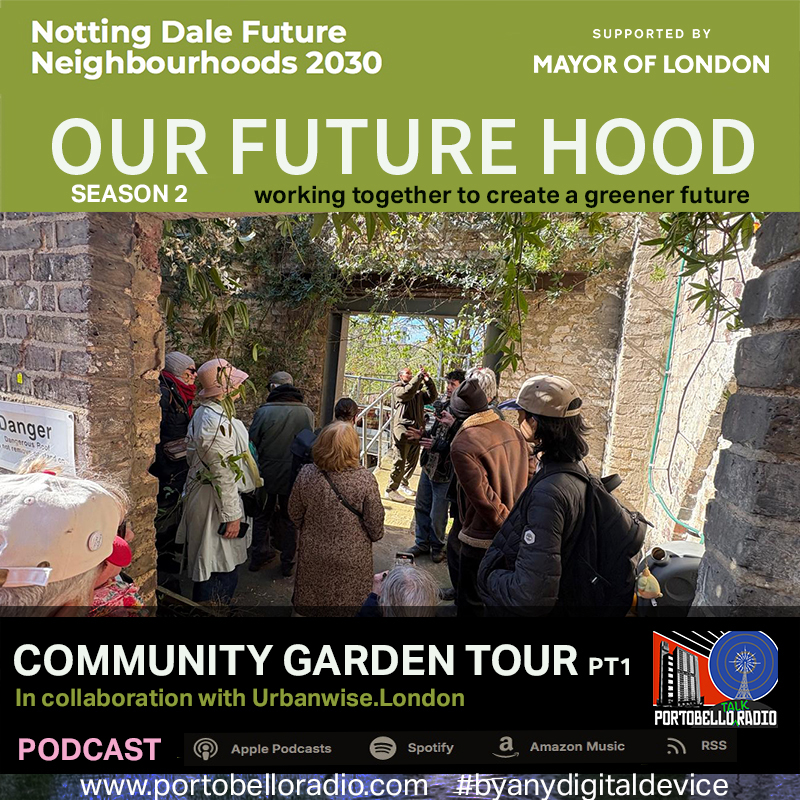
In this series we are working closely with local community groups. And in this episode we went on a community garden tour of Nottingdale with Urbanwise London. We started by finding an oasis of green and calm behind a black dawn Labrador Grove.
[00:00:49] Speaker C: Good morning everybody. Thank you for joining us.
I'm Carlos from Urban Wise London and I'm kind of one of the organizers of the walk today together with Piers from Portobello Radio and our friends from Portobello Radio and we support from the future neighborhood. And the idea today is to do a walk and talk visit to some of our community gardens. Starting with the Energy Garden, followed with the garden the emission of brands.
Then we go to the Henry Deakin State and then to the Lancaster West. And the idea is to learn about what's happening in these gardens, opportunities, what's going well, perhaps what are challenges they're facing and how we can work together as a community to strengthen our community gardens, to promote them in the community and. Yes, and to be able to provide access to these places to our community. So we start with a visit to the Energy Garden and then there. Callum will be there and yeah, we'll take it from there and if you have any question, comments, let us know. The idea is to. We'll be working for about a couple hours we saw for lunch at the resource center and then maybe there we can have some discussions in terms of how we continue supporting the community garden work. Thank you.
[00:02:15] Speaker B: So today, this morning we are outside Labrador Grove Station. We are about to enter the Energy Garden which I'm really excited to see as I've not managed to have a little peep in there yet. So stay tuned and follow us into this amazing space.
[00:02:32] Speaker A: Welcome to the Secret Garden.
[00:02:35] Speaker B: Hey yeah, nice to meet you properly.
[00:02:38] Speaker D: So in all my.
[00:02:40] Speaker A: In all my 33 years and plus I've never seen this, never looked at this door. Black door had so much behind it.
[00:02:48] Speaker D: So.
[00:02:48] Speaker A: So let's get in there. But yeah. Welcome to the Labrador Grove Station Garden. I can start off with a little bit of history of the project started in 2023, 2022.
Around about the same time, there was a group of local activists, Zakiyah's mum, Isis, who I'm sure you're all aware of, Pan, Prader, Toby, Laurent, Belson and Elaria. We.
I'm working with Energy Garden and we were sort of exploring this space at the same time. And so we basically began a collaboration with RBKC and the local group. And, yeah, we've been gardening here for now three years, and it's sort of gone over quite a transformation in that time.
We do regular gardening sessions here every Wednesday, hoping to expand to more sessions and more people.
But, yeah, we're really starting to get rolling. We have around six volunteers every week, guaranteed. People come skipping into the garden. It's a great space.
[00:03:50] Speaker B: That was. Yeah, that's amazing. We're really excited to see the space.
Has anyone in here been here before?
Okay, so some people have been there, some haven't. So listen, I'm excited to see everyone's reaction to the space. Right, so how did this space. How did they find this space that was like, empty and unused? Like, did it just. Someone. Was the door left open or did someone know about it and inquire about it?
[00:04:12] Speaker A: So I think it all began with a station staff member.
I can't remember her name because it predates me, but basically I believe she was looking for help and got some help from your mother, Isis, and the group. And then they needed sort of help to access funding, and that's where Energy Garden came in and sort of collaborated with our BKC and we got the Future Neighborhoods funding. And, yeah, that's really brought the garden forward and it's allowed us to sort of curate the space slowly and let it grow naturally. And, yeah, I don't believe that the staff member works here anymore, so I'd love to have her back and to show what we've done. But, yeah, the station's got a really wild history. It's one of the oldest in all of the TFL network.
And this space actually used to be sort of a railman's yard. So it was where they'd have all of their tools and equipment for rail repair. And actually, this room that we're standing in was probably, as far as I've been told by tfl, was the station master's house. And you can see. So we're in the Vine Room right now, which has a load of clematis and passion flower and jasmine and.
And sycamore saplings, but we'll get rid of those soon.
But you can see in this corner, there's sort of a. An angled wall on this side and that is actually supposedly the chimney funnel for the station master's room. So this used to be where the station master would live. He lived in the quarters below and then.
[00:05:50] Speaker E: Yeah.
[00:05:51] Speaker A: Was he quite small? I think he was probably as small as a mouse. Yeah.
So that's sort of what Energy Garden and other communities are doing across London, is sort of taking back these spaces and creating gardens for both the staff, for the community. And. Yeah, I think it's really important because stations are places we wait a long time often and to have spaces like this is great. And. Yeah, so this vine room was the first thing we did as a group and we built these planters on the side and we've kind of built it as like a. An area for relaxation and sort of quiet contemplation. And often if, you know, you have someone who needs to sit down or we need a cup of tea, we'll come here and we'll just sort of relax. It's really nice space for that and then moving on. This is our platform area, so
[00:06:42] Speaker D: it's.
[00:06:44] Speaker A: It's in a bit of disarray quite, quite currently because we were hailed on mid horticultural skills last night in the session. But yeah, hopefully we're going to be building some extra seating in here and having this as another facilitation area for workshops.
But behind it you can see this. This is our rubble garden.
So if we move forward, so everyone can see.
There's quite a funny story about this one is basically, you can see that this building behind us is being taken down.
They're building some flats and it's probably going to disrupt our gardening sessions a bit this year. But it's been on pause for two years because they didn't tell TFL that they'd be doing it. And there was some. Some issues there. But I saw them working on it and I was like, can we have some bricks? And because I like to do circular economy and sort of reusing what's local, we've not really brought anything new into this space, so to speak. Speak. But I came back the next week and they'd knocked the whole wall down into the garden.
You can see the huge rubble pile over there. That's basically what they did. And I was a little bit annoyed and it took me about a month to realize that it could be a good thing. So in the following month we basically moved a load of the rubble up the bank and we built this rubble garden. So it's. It's basically, it uses a lot of bricks and big chunks of the wall.
And then interspersed with that is old found objects from the rail breakers yard that we sort of scavenge from the site.
[00:08:23] Speaker B: I can see there's a. Like a baby's trainer in there. It's a small trainer. And then is that purple flower. I'm guessing that's. That's. Is that something that you guys found as well?
[00:08:32] Speaker A: It's like a seed. It's a sedum.
[00:08:34] Speaker B: Yeah.
[00:08:34] Speaker A: So we. We picked out all the varieties that would do really well in poor, sandy. Poor quality, sandy soil.
And this area gets full sunlight all day. So Mediterranean varieties really thrive in this environment. And it was sort of a good learning activity for our volunteers and we all sort of pitched in naturally. This walkway we're on right now was probably a meter lower and just one big bank. So we really sort of transformed this little area.
And later this year we're going to get some trellises up and we're going to do wisteria and jasmine along these arches. So it's going to look really pretty and adding some more Mediterranean varieties as well. But, yeah, it's looking great.
[00:09:24] Speaker B: I think it's really amazing how you're using what you have around you to create something beautiful and it kind of shows you that you don't need a lot of money. You just need people with a passion and, and love and care and you can create something beautiful that people can enjoy. And. And it's. Yeah, it's amazing. It's really nice to be here. So. Thank you.
[00:09:43] Speaker D: Thanks.
[00:09:44] Speaker A: Yeah, yeah. I always believe that before you sort of buy in materials, you should see what you've got already. Whether that's fell trees and logs or bricks or whatever. The sleepers, even on the walkway, they were just, you know, from a local garden in Brunesbury. So, yeah, it's sort of. I think it's the best way to design, really.
I mean, are we really in North Kensington off Ladbroke Grove?
[00:10:11] Speaker C: Are we?
[00:10:12] Speaker E: Are we.
[00:10:14] Speaker A: Yeah. It's amazing to think that this bank a year ago had no plants on it, really. We planted this whole area in April, and then later in the summer, we realized that a lot of the sort of rubble and scree from the upper bank was sliding down and damaging plants. So we created this halfway path and then added these sleeper borders which sort of retain the wall and allow all of the plants to sort of thrive and not sort of expose their roots when the. When it rains and sort of everything rolls down the hill and so the bottom level is medicinal and then the upper we've gone for what we call a Jurassic planting. So it's tall, alien looking plants that sort of give a bit of dramatic impact to the area. And then we've got our lovely Acer, the Japanese maple over there.
[00:11:13] Speaker B: Which one's that one?
[00:11:14] Speaker C: Sorry?
[00:11:15] Speaker A: It's the yellowy ready sort of leaves.
[00:11:18] Speaker D: Yes.
[00:11:18] Speaker B: Yeah, they look really nice. Yeah.
[00:11:19] Speaker A: And yeah, it's, it's really come along in the last year and yeah, that was the main focus of last year was the sort of area by area build better and allow for planted areas to thrive. So this was last year. We're light touching this one. Sort of just maintenance gardening this year and our main focus is further down this way now. So.
[00:11:45] Speaker B: Yeah, on down there.
[00:11:46] Speaker C: Have a look.
[00:11:47] Speaker A: Yeah, yeah. The first two meters of it was cleared in the last month, so we had ivy sort of stretching down.
And what we're trying to do in the next month is to regain a bit of the bank and flatten it out. And then we're going to create a dead hedge which is we'll utilize all of the dead twigs and big sticks that we have in the garden and we're going to create this long wall which will utilize all the old sticks and, and also create a nice border that provides a home for biodiversity and also a learning opportunity for anyone who comes into the garden. And yeah, so it's part of the development of the spaces. We're just moving more down this way this year and yeah, problem solving with things that come up by sort of relocating these materials and finding a better use for them.
And yeah, so that's our next month of workshops.
On Wednesdays we'll be just focusing on building.
So every Wednesday we meet from three till six, so it's just moved further backwards into the evening so we can get more people who are like working during the day. So eventually it'll be from 3 till 7 in the summer months, but we sort of push it back hourly as we get more light in the evening. But yeah, it's, it's really nice to have the longer sessions. You know, like four hours in the garden really means that, you know, people can come in and out of the space. It's a drop in. So even if you want to stay for half an hour, you can just come have a cup of tea and maybe get your hands in there for a bit. But you know.
Exactly. Yeah, yeah. So if we move along down this way, I can show you some of the plans we have and we've Seen,
[00:13:35] Speaker B: obviously, the plants that you have up there, are they all the plants that you found here or have you kind of brought them in from other places locally or other kind of green spaces?
[00:13:45] Speaker A: Yeah, so it's, it's a big, quite a big mix, actually. So obviously we, we tend to not to try and remove any vegetation or any plants that have existed in the space already, maybe ivy or brambles, because they're, you know, they're going to keep growing and they'll come back. So it's almost maintenance to keep them from taking back spaces.
But yeah, Energy Garden grow a lot of stuff in our polytunnel. So we have, you know, every year we sow our seeds and we have like a list of favorites that always seem to work well in all of our spaces.
And then we always do a big spring plant order. So we'll each garden, Energy Garden has a budget and of that budget, you know, every year we'll spend at least £200, but up to 500 if we have a big push of a project.
And those will come in yearly. So, you know, we have a yearly sort of push for a spring planting and then we'll hold an event. So I've not locked down the date yet for elaborate grove, but I'll share it with you guys so you can propagate that around your circles. But yeah, and then later in the summer, after Chelsea Flower show, we often sort of collaborate with the designers and the gardeners who are doing shows there. And we'll say, let us re home your plants. We have loads of spaces. And so, you know, all the bushes and all of the plants in these beds were all rehomed from Chelsea Flower show last year. We'll have another batch this year.
Last year we worked with these designers who had the garden of the future. And, you know, they donated probably about 35k's worth of plants, which we spread out across a load of different projects. And, you know, some of the interesting things that we had in that delivery were like chickpeas, which I'd never actually had off of a plant, but they're delicious off the plant. It was really cool.
And. Yeah. And then eventually, you know, at the end of the year, we also do bulb planting. So we always get a big batch of bulbs and that's sort of our rounding off the year.
That's one of the sessions we like to do in November.
[00:16:02] Speaker B: Yeah, I love that. That's really nice. So you get. You use what you have around and then you kind of reach out to places that would potentially Be throwing away their plants so you can rehouse them in the different gardens across London or the uk.
[00:16:14] Speaker A: Yeah, of course, London. Yeah. We're only really active London based in London.
[00:16:18] Speaker D: Yeah.
[00:16:19] Speaker A: But, you know, we're in all four. Four corners. Yeah. So last summer we had our five steering group members, the activists I was talking about earlier.
They did six workshops each in the garden. And so we had.
We had the Ilaria doing the crochet, so we adorned all of the trees in the space with handmade crochet, sort of to embellish them and make them look pretty.
We had. Toby was doing his clay workshop, so we made clay tiles which will be eventually put up around the gardener sort of art.
We had ISIS doing Exotic Fruits of the Global south. So we had the pawpaw, the soursop and can't remember the third one. But yeah, it was basically talking about the histories of these plants, where they come from, how we connect to them in London as, you know, this sort of duality between living somewhere but also feeling like you're from another place and wanting to sort of blend these two feelings. That was a really great workshop.
And then, yeah, to talk about the Forest School, we had Pan Prader, who did six Forest School workshops and they focused on using things in the space to create, you know, new additions to the. To the garden. And actually this was all funded through future Neighborhoods, as was the whole project last year.
[00:17:52] Speaker B: And I mean, I could imagine what this space would have been like before you guys entered it. Probably just underused, full of crap and rubbish. I mean, I. I can't. I feel like the air is cleaner here on this side of the gate, so we need more spaces like this where we can breathe, you know.
So, yeah, thank you very much, Callum, for bringing this to the area and helping support it is much appreciated.
[00:18:16] Speaker A: Thank you. Yeah, cheers for all of you coming today. It's been so nice to show you around and I really do hope that some of you come back and, yeah, we're looking to open it more often and have more people in the space. You know, every little helps in this sense. This really is one of London's best guests.
[00:18:34] Speaker C: Congratulations.
[00:18:36] Speaker B: Sorry, I just got one more question for anyone that's going to listen to the podcast. How can the local community support this project? I know that you're looking for volunteers, but is there anything else that we can do to make sure that this garden is sustainable? Is it dropping off plant pots? Is it dropping off plants? Is it contacting you if they've got something that could be Planted here. Like, what is the best way that people can support.
[00:18:57] Speaker A: You can always contact me with any idea.
My email is Callum with two Ls, energygarden.org UK so you can always contact me and I'm always really up for unique ideas or to come collect plants that you might need to get rid of.
If you're, you know, moving house and you want to get rid of some of your plants, we'll come by and pick them up.
Also, just telling people about it. It is the Secret Garden, but we'd rather it wouldn't be if, you know, people who need to get out and they want, you know, maybe they've just lost their job and they need something to ground themselves with. We really find that people get strength from being in the garden space and, you know, having something to anchor their week to. So I think, yeah, we can help you and you can help us. So, yeah, it goes both ways. I think it's really important, Carlos.
[00:19:52] Speaker B: So we've just finished up at the Secret Garden and we're all heading up to the Museum of Brands. For those that don't know, it's on Lancaster Road Road and it used to be called known as the Lighthouse.
So we have now arrived at the Museum of Brands. We are with Gary, who's going to tell us more about this beautiful garden that we're outside in.
[00:20:14] Speaker D: I'd like to introduce Peter, who's following here.
[00:20:17] Speaker E: Hello. Yeah, I just want to say a little bit. Welcome, everybody. Thanks for bringing the sunshine. You did well.
This is the memorial garden. It was set up in 1990 to provide a safe and peaceful space for those who were using the services of London Lighthouse, which was the service for people living with aids, their families, their friends, their relatives.
People come here and say, this is an oasis, it's a haven. Those are the words that most often get used.
It's a place where there are many memories. There are also many ashes of those who, unfortunately died from aids, who were using the services.
So it has a long history.
It's a place that we maintain with a very small but diverse group of volunteers and with Gary the gardener, who. Gary was responsible for building this garden in the first place in 1990, and he's still here with us. So I'm going to hand over to Gary and then I'll say a little bit more afterwards.
[00:21:22] Speaker D: I still standing after all these years. I started in. I think I first came in about 1988 and there was just a cement courtyard here. There was very little planting.
The building originally had been a Jewish school 1860 ish.
Then became a Spanish community center, which the project failed. And then it became the London Lighthouse, the HIV AIDS center, which was a prototype for the world. So it was very, very important, visited by people from all over the world and it did great works here.
So we were gifted one of the Chelsea Flower Show Gardens. It was Crabtree in Evelyn, now defunct. And we got about three lorry loads of plants. Just. It was a Tudor rose and herb garden and it was massive.
We were completely overwhelmed. So we just sort of dug it up as we went along and we incorporated most of the those plants into the garden. A few of them still survive. That was a very long time ago.
We are a sun trap. We face south. When I started, that huge sycamore there was just barely at the top of the fence there, so we had a lot of sun. And over the years we've lost an enormous amount of sun.
So we've had to change the planting. And of course, the climates changed during those years. We had. Was it during the 90s, I think we had almost tropical winters here and we had an enormous number of delicate and tropical plants that we quite got off on being able to do this very special growing. And then the climate changed a bit again.
So we just have to go with whatever the climate throws at us. At the moment, we're replanting and putting in a new irrigation system. So it's in a bit of disarray, but we'll get it together.
What do we have? We have some of these trees have been replaced. We've got this mimosa that has just finished.
This mimosa blooms before the mimosa bloom in bloom in Italy. You can believe it, this. When was it, Peter?
[00:24:05] Speaker E: December 11th. It bloomed this year three weeks earlier than usual. What does that tell us?
[00:24:10] Speaker D: It's just wrapped up now, so it's quite a sight.
And it provides lovely shelter here in the summer sun.
And then we have a paulownia over there, which is about a foxglove tree, which is about flower.
It makes lovely mauve candelabra like flowers. We have wisteria. We have a banana.
We've got kiwi. We have two chujan palms back there, figs behind you.
This is a great white cherry here.
It's been mugged by the mimosa. But we're trying to get a sort of balance so they can live together.
So it looks like it's working at the moment.
This tree was thought to be extinct, that it only existed in paintings, Japanese paintings, and they may have been in the 1980s. That's probably not right. They found one in a garden in England, and hence we now have the tree again. It lives in the real world and they were able to send cuttings back to Japan, so it's been returned to its source.
[00:25:31] Speaker B: That's amazing. So we had a bit of Japan here and we sent it back to them and now it's grown back there as well. North Kensington is connected to everything, isn't it?
[00:25:40] Speaker A: Yeah.
[00:25:41] Speaker D: In the past, we designed the garden. It's a small garden to try to make private spaces. So we tried to create rooms where people could talk and meet their friends and whatnot.
The top floor was a residential unit where there were a lot of very ill people and the garden was very important for them, so they could get down here and meet their friends or be alone, even. So. So that. I think it was much loved back then and used. And also the community used it. They came in.
So it's sort of always been open to everyone that comes by, really.
[00:26:26] Speaker B: Yeah. I actually did an interview here for Grove Root, so we interviewed Mary Gardner somewhere over there for a documentary about the local area over 15 years ago now. So it's really nice. Like, it's a beautiful space and you're right to call it an oasis because it is a special little oasis within North Kensington. And you don't realise it's here until you come and you're like, oh, I've been walking past there my whole life and I haven't engaged with it. So it's really nice that it's still thriving and it's still going and it's over 30 years and it's still being used. So well done to everyone that's part of the team.
[00:26:56] Speaker E: Thank you. One of the things I really love about being a volunteer here is the number of people who come and tell us stories. I've started collecting them. People who come and say, well, I had a relative who used the lighthouse and they were. They contributed in some way to the history of the garden. People come and share their stories in a very.
In a way, intimate way, but very. I feel always privileged to have that sort of sharing. So we're gathering them up in those
[00:27:24] Speaker D: stories and we have people who come by who were students at the Jewish school, which is quite a surprise that they. And they tell us stories about being at school here.
[00:27:37] Speaker A: And if you want to volunteer, 1. How do you reach out and can they volunteer anytime or do you have specific times?
[00:27:48] Speaker D: Thursday is our usual work day, but people who are experienced gardeners or can do a particular task like watering. In the summer we have a lot of pots. It's a very important thing so people can come by when they've got time to work on their own here.
[00:28:07] Speaker A: No water butts.
[00:28:09] Speaker D: Yes, we've got water butts. We have three water butts.
[00:28:13] Speaker B: I want to say how lovely it
[00:28:15] Speaker D: is to volunteer here because they're very
[00:28:18] Speaker B: welcoming and warm and you can come in anytime. So I've volunteered a few times, but I'm not able to come all the time, so I feel very welcome. I love just getting stuck in to whatever is needed doing.
[00:28:32] Speaker A: Are any of your spider plants here?
Not yet.
[00:28:40] Speaker B: Thanks for listening. Make a point of visiting some of the secret and not so secret gardens in the area, and watch out for our other collabs with Kids on the Green Nova Youth Voices and the Kensington and Chelsea Youth Council.
My name is Zakiyah. This is Portobello Radio, your local community radio show station. All episodes of our future hood are available wherever you get your podcasts. This series has been supported by the Mayor of London.
[00:29:07] Speaker A: You are listening to Portobello Talk Radio, the authentic voice of Letbrook Grove.