Episode Transcript
[00:00:02] Speaker A: You are listening to Portobello Talk Radio, the authentic voice of Letbrook Grove.
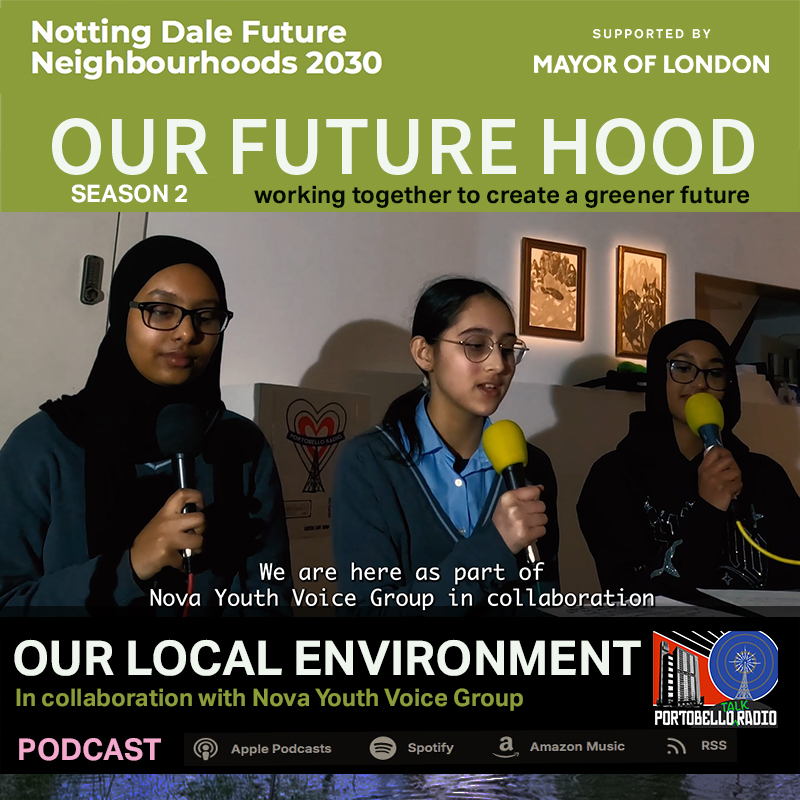
[00:00:08] Speaker B: We are NOVA Youth Voice Group. We've been learning how to use our voices for good and make a positive impact on our community, as well as to speak up for others. We have designed and led a project called Our Local Environment which gave us a platform to create change.
[00:00:23] Speaker C: We've trained with a BBC journalist and documentary maker to film our own interviews with members of our local community to gain their opinions on the local environment and how it could be improved. We also took part in public speaking workshops with Imperial College and later hosted our own stall at the Natural History Museum, interviewing international visitors about their experience with the environment in London.
[00:00:45] Speaker D: We are taking part in this podcast to have our questions and the concern of the local people that we interviewed answered. Let's listen to what people think.
[00:00:55] Speaker E: Why does the environment matter to you personally and how does it affect your everyday life?
[00:00:59] Speaker F: Personally, I love greenery, so even at work, if I. I can sit near a window, I prefer a window seat so I can actually see the environment, see nature, because it's where I'm raising my children. It's really important going forward for the future generation.
[00:01:15] Speaker G: Well, it's a question of survival, so it's not a question of fun or it's not a question of nice to have. It's absolutely necessary.
[00:01:25] Speaker H: I have respiratory illness, I have allergies, and that's made me more focused on what is in the environment that is actually attacking my system.
[00:01:34] Speaker B: Have you noticed any environmental problems in our community?
[00:01:37] Speaker I: The trash, especially from the tourists and also from people who just don't seem to care about other people in the community in the way that they handle their own personal trash. And I think that one of the main problems with that, apart from sort of hygiene and those kind of things, is rodents. It's rodents.
[00:01:54] Speaker H: We're quite a unique area because we have five streams of pollution. We have the overground, we have the canal, we have the road, British Rail, and then we have the flyover. So for such a small area, we are very compacted with a lot of pollution.
[00:02:14] Speaker A: If you could make one big change in our environment locally, what would it be and why?
[00:02:19] Speaker J: There could be more bike lanes. There could be more bike lanes, yeah.
[00:02:22] Speaker H: Would ensure that. We have quite a number of monitors,
[00:02:26] Speaker K: air pollution monitors, more accessible areas for leisure bins and probably recycling bins beside them would be a really good idea.
[00:02:34] Speaker A: Active travel. Let's all get on the bikes. Let's get healthy, let's get fit, let's stop driving.
[00:02:40] Speaker G: I Don't believe in the big change on one place. I think a lot of small things has to be done and as I mentioned before, these to transform one or two or three of the London greens into a forest.
[00:02:55] Speaker A: How would more trees, plants or natural spaces in our area make a difference to you or your family?
[00:03:01] Speaker K: Mental health level, I think that's a very good thing. It's also bringing more oxygen into the area, bringing pollution down, but definitely on a mental health, having green spaces around you is so important.
[00:03:12] Speaker I: And the wildlife as well, which we do have.
[00:03:14] Speaker F: I just wish there was more of it, just more greenery, more green space. Just so you know, if you live like in a council flat and you've only got like a windowsill for greenery, just more opportunities to just see nature without kind of making a great big trip out of the city, it'd make
[00:03:32] Speaker J: everyone a lot happier. Mental health was there wouldn't be so much. It wouldn't be such a concrete jungle, you know, it'd be more of an actual jungle.
[00:03:38] Speaker B: Hi, I'm Aisha, this is Yara and Samaya. We are here as part of NOVA Youth Voice Group in collaboration with Portobello Radio to talk with Charlie from the Natural History Museum about our research findings about the local environment. So, Charlie, over to you.
[00:03:52] Speaker A: Thank you. And yeah, thank you so much for having me on. My name is Charlie and I am the policy officer at the Natural History Museum in London, so not too far from where we're based now. And what my role really is is about trying to engage both scientists, but also the public with all of the amazing research and programs that we have at the museum to ultimately try and solve some of the problems and the questions about the natural world that we all have. So, yeah, thank you very much for letting me talk with you.
[00:04:15] Speaker E: Thank you. So we have some questions for you. We all know about the dinosaur and whale displays around the Natural History Museum. To pick it the place we love. But what research is happening behind the scenes at the Natural History Museum?
[00:04:27] Speaker A: Yeah, it's a really good question and I think often you might hear us known as the Dinosaur Museum. Right? That's what people know about us. I think most people probably come to the museum for the dinosaur gallery and it's a really important part of the museum because that's often how we engage with people in the first instance. A lot of kids really like the dinosaur gallery and that's how we start to get them interested in the natural world. But we're so much more than just dinosaurs and whales, even though that research is so important. What most people don't know is we've got about 450 scientists and also PhD students that are working on everything from monitoring biodiversity around the world to understand how nature is changing, to how do we make sure we can move to a greener economy, all the way down to what's the origins of planet Earth, and even around evolution as well, trying to find solutions from and for nature that ultimately can solve the planetary emergency that the museum has declared. So it's a wide ranging amount of science that goes on that probably covers mostly anything you can think about about the natural world.
[00:05:18] Speaker E: And how do you use this research to make policies?
[00:05:21] Speaker A: Yeah, that's a really good question. And I think maybe it's worth clearing up. Firstly, what we mean by policy, because I think often not everyone really understands what policy is. So when we talk about policy, we're not talking about policies that the museum has to run itself. So how it might run as an organization, actually, what we're talking about is policies that governments or maybe other global act use to decide what they're going to do about a problem. So they might think about climate change and think what's the course of action we want to take to actually solve that problem. And that's the policy that they take forward.
So obviously we're not a government, we're not an organization that has that sort of power to make that sort of decision. But what we can do is use the science that we've got and the trust that we have from the public to try and inform those decisions. So a big part of my role is trying to take all the amazing research that the scientists do at the museum and get it in front of policymakers, decision makers, so that they can make the best informed decisions about the natural world. So I'll give you an example of how we might do that. One of the projects that I work on at the moment is for something called 30 by 30. And what that is is a big global conservation target to try and protect 30% of nature worldwide by 2030. And what we're doing is using the data that we have at the museum on how biodiversity is changing to try and help countries that also national actors like businesses understand, well, where should we be protecting that nature? Which 30% should we protect? And what are we actually gaining from protecting those parts of the planet? Maybe it's food, maybe it's the clean air that we need to breathe, and trying to understand a little bit better about how best to implement that policy on the ground so that's kind of a case study of how we do policy at the museum.
[00:06:48] Speaker E: Thank you.
[00:06:50] Speaker D: How can we improve air quality sustainably?
[00:06:53] Speaker A: And that's a massive question. Right, so let's break it down. So I think the broad picture is the problem with air quality, and the reason why air quality is decreasing is because of pollutants in the air. Right. We're polluting the air, and often that's through something that happens when we burn fossil fuels. So fossil fuels, obviously, when we burn them, they release gases into the atmosphere and that's what heats the planet and that's what's causing climate change. But more than that, it also releases dangerous pollutants into the air that affects how we breathe and our health as a result. Right. So often this is from polluting practices like burning fuel for industry, or maybe it's through driving or agriculture, whatever it might be. Ultimately, the broad picture is we need to move away from burning those fossil fuels and the way we clean our air is starting to move towards cleaner ways of producing our energy. So you might think about solar panels, you might think about wind turbines, these big, big system changes that we need to see.
Ultimately, we can't do that ourselves. Right. We can't decide on our own to move towards these cleaner energies. But what we can do is work within our communities to think about how can we encourage that movement away from, you know, maybe away from driving, or maybe it's away from unhealthy practices in industry.
Sometimes people think about community energy as this new thing that we can get involved in. And there might be groups around us that can work on those together, but also on an individual, how can we reduce our energy consumption on a personal level? Maybe it's by using less energy at home and in school, in the office, maybe it's by moving towards more active modes of transport, like walking, cycling, even just using public transport as well. But ultimately trying to build the consensus and the momentum behind individuals to want to move towards this cleaner future that we ultimately need to see, because we know how bad air pollution can be for our health.
[00:08:34] Speaker D: How do cars contribute? And do we need more rules around cars?
[00:08:37] Speaker A: Yes. So cars. So as I mentioned, cars is kind of one of those areas where that's easier for us to kind of understand because it's a more individual. Individual area. Right. So cars, the way that cars run is they burn fuel that produces the energy they need to then power the car, and the fuel that they burn releases these pollutants into the air. And that's why often, if you're on, like a busy road, you might feel like the air is a little bit heavier. When you're in a particularly congested city, often people complain about it being a bit harder to breathe and it especially affects, you know, people with breathing difficulties, but also older people and really young people. And that comes into this whole question around, you know, there is this kind of social justice element to climate change as well that air pollution really brings to the foreground. But cars specifically, so there is. There is some movement. So electric vehicles is a big move towards electric vehicles, which are much cleaner to run than normal petrol or diesel cars. They're not perfect and they still require, you know, these fuels to make the cars, but also then to keep them running.
But that's a big move away as well. And it's also worth saying that especially in London, there's been actually quite a positive story around this move away from cars and helping air pollution and air quality. I don't know if you know about ULEZ as a thing, but ulez, for those that might be listening that don't know what ULEZ is, stands for Ultra Low Emission Zone. And that's something that London has been slowly broadening out across the city, which is essentially a scheme that means if you drive a car that's not running on really clean energy, you have to pay a small fee to then drive in central London. And what it's done is massively reduce the number of people that are using or driving these dirtier to run cars in London and has really improved the air quality. So only really recently, London has actually reached legal limits of air pollution, which is amazing, and that's an amazing achievement. But it shows how these kind of individual actions can contribute to that wider change. So do we need more rules? I think there's always more we can do. And I think part of it comes down to what we're able to do as individuals. Not everyone will be able to stop driving, but some people might be able to.
But then also understanding how these individual actions ultimately can add up to that broader change that we want to see.
[00:10:37] Speaker B: A lot of people we interviewed mentioned. Litter. What are the bad effects of litter?
[00:10:42] Speaker A: Yeah, it's a really good question. And I'm not surprised, actually, that most people mention litter, because we see this as well in the museum when we talk to people. If you think about, you know, how we understand and how we visualize environmental change, environmental damage, litter is a really visual thing, right? Like we can see litter on the ground, we can see that there's a problem, that it's not meant to be there in a way, actually, where you might think about air quality. You can't see it, it's invisible. How do we really know it's there? If you're not knowledgeable in this area, you don't work in this area. You might not really understand what it is. So this is a really good example of how we can actually get people involved. But it is really damaging at the same time. And I'd say there's probably three main issues with litter. The first is it causes pollution itself. So litter can pollute the soil beneath our feet and it can also pollute our water sources. And that ultimately is a massive problem because it can feed into the food chain, so it can be taken up by plants, it can affect everything we eat, the livestock we rear, and then ultimately there's bigger problems for our health and everything else that goes along with it as well. So pollution is one element. The other element, which is a massive one, is harm to wildlife. You know, we've all seen the images of wildlife that gets stuck in plastic, for example, in the ocean.
We've actually had a former scientist at the museum who found plastic inside nearly every crab that he collected as part of the museum. So it's a massive problem. It's been found inside whales, it's been found inside seals and porpoises, and ultimately, you know, that affects the whole ecosystem around it as well, when we think about it. There's another study that found that 80% of waste on the shore of the Thames is plastics, and most of that is wet wipes. So, you know, this is a problem that we're causing through the litter that we do and has an effect on the animals and also an effect on the habitats that they. That they get involved. And that's the kind of third one as well, is how does that littering actually affect the habitats that these creatures and wildlife live in and that we also live in as well?
[00:12:25] Speaker B: Since you mentioned plastic, how can you. How can we get more people to recycle better?
[00:12:30] Speaker A: Yes, well, so two things on that. Firstly, plastics isn't the only problem. It's not the only thing we need to recycle. It is a big problem, you know, and a big problem around plastic is that it doesn't degrade very easily at all. So around 80% of all plastic that's ever been made is still in our environment.
80% is nuts. You can't really get your head around that when you think about that number.
So we need to think about how we recycle better because if it's not going to degrade and it lingers in our environment, then we need to take it out of the environment and keep it in use. Ultimately, we want to reduce how much plastic we need. So the ultimate aim shouldn't really be recycling. It should also be reducing how much we need, how much we produce, how much we consume.
But if we do think about recycling as a really powerful tool for getting people involved, there's multiple ways you can think about doing it right. So most of us have heard of recycling. That's a big first step in terms of building people's engagement around tackling climate change. And ultimately, it's about education. So making people aware of why they need to recycle, making sure that if we run an office space or if we are in a school, that we've got bins next to waste bins that are also for recycling, that they're labeled in the right way and we understand what we put in each bin and how we don't contaminate recycling, which is another big thing.
The other thing I think is important is make it fun. Fun, like recycling is not a very fun thing to talk about.
We've got something at the museum that's just started, which I think is brilliant and quite a good example from our sustainability team. So what they've done is they've created a new kind of friendly competition between staff where we complete little sustainability actions, one of which is recycling more. You get points as a result, and then there's a leaderboard within all staff who can get more points, who's doing more sustainable actions. And it's little things like that that, you know, can turn these quite mundane, quite arduous things for a lot of people, actually, into quite a fun, friendly competition that gets people doing more and gets people excited and builds that sense of community that's really important when we think about how all these actions add up to create real change as well.
[00:14:20] Speaker D: Is meat really an issue in climate change?
[00:14:23] Speaker A: Yes. So this. This is the big one, isn't it? Meat. This is often the issue that people talk about when they talk about tackling climate change. And it's probably worth saying in the first instance, not on its own. So meat in itself is not bad. The problem is what we do with meat and how we make our meat. So the real issue behind meat is the fact that we produce it in really, really large scales and really, really intensively so. About a third of all land on Earth is currently used for farming. So that is whether it's rearing livestock like that we need for meat, or whether it's creating the food that we need to feed that livestock, a third of all lands, it's a massive amount of land and that takes a huge amount of energy to produce and then to keep and then to process as well.
But it's also worth broadening it out as well. Beyond me, you know, dairy is really, is also a big, big factor. You know, you think about cheese creates, needs a huge amount of water to be produced. Rice, which is something we don't really think about, creates 10% of all emissions that comes from the sector. And even something like cocoa that we need for chocolate requires a huge amount of tropical deforestation. So there's lots of different things. And I think really it's about thinking, yes, meat's not brilliant, but it's also that wider picture of our diet and really understanding what is it that we're consuming and how has it got to the plate in front of us and what can we do to reduce the impact that we have? You know, the other thing to think about is not everyone is as willing as others to reduce their meat intake. And it's about actually how do we bring everyone along with us together to try and reduce our consumption. And some of that may be through reducing meat, but it may also be about thinking about other parts of our diet as well.
[00:15:53] Speaker D: Do you believe eating bug is a realistic alternative? And have you ever eaten a bug?
[00:15:58] Speaker A: So, yeah, it's a really good question. And you feel like you see this more and more, right, in the news and people talking about bugs, so scientifically and, you know, I've spoken to some of our scientists at the museum about this. Scientifically, it is a really good alternative. It's really low in fats, it's really high in protein, it's got loads of the nutritional, like, instruments we might need, like some iron and zinc, those minerals we really need to be healthy, but with a much, much, much lower carbon footprint. Right, which is ultimate, the aim. So how do we produce the same level of the nutritional need that we, that we need, but with less impact on our environment around us? So on paper, yeah, brilliant.
Obviously, the problem is the cultural side is the cultural barrier.
Especially when you think about, you know, There are about 2 billion people worldwide that already eat insects as part of their regular diet. Right? That's not this for them. This is not an unusual thing in the way that, you know, we find it quite funny and quirky to still think about eating insects. It's a massive cultural barrier. So I think, you know, the question really is, will we get in the UK or in other countries where we don't eat insects in the same way? Will we get to a position where that is part of our diet or not? I don't. Don't know whether it's the answer.
Have I ever eaten insects? I have tried insects. I tried it. I've tried it once. And this shows the kind of cultural barrier.
I tried insects on a holiday to Wales. I went with some friends a couple of years ago, and we've been like, on the rural coastline of Wales, very West Wales in Pembrokeshire, for about a week. And we've done loads of walking.
We'd had beautiful weather, and then the final day it completely poured with rain and we were like, we just want to do something else now.
And nearby there was a bug farm where they rear insects, and then they also have a restaurant on site where everything they make is made with insects as well. And none of us have tried it before. We were like, let's give it a go. It's raining. This is something fun to do without having to go on another massive drenched walk.
So I had a bug burrito for lunch, which I lay the scene for you. It's like a deconstructed burrito with all your usual things. You got your beans, you got your red vegetables, your wrap and everything.
And then they have these cubes of something called Vexo, which is kind of like fake meats, but made out of insects. So you'd never know it was insects unless I said to you it was insects. But then the killer was that sprinkled on top. They had whole crickets just all over the top.
And that was the bit I remember looking at the plate going, I don't know if I can do this. And I'm the one that even works in this world.
But, you know, we ate it. It doesn't taste bad. It actually tastes like chicken. I mean, I don't eat it anymore, but when I did, it tastes very similar.
You just have to get over that kind of mental barrier of, you know, this is something that you can do. So I've given it a go. I haven't made it a regular part of my diet yet. Whether I do in the future, I think, depends partly on how we kind of change that culturally as well. But it's a really interesting question as to whether we do get to a point where we can start to move towards that as an alternative to meat.
[00:18:38] Speaker E: Thank you for sharing that story.
Nearly everyone knows about the struggles the Earth is facing around climate Change and the environment. But not everyone is ready to make movement to fix this. What do you and your team think we can do to implement the ideas and strategies you can come up with?
[00:18:55] Speaker A: Yeah, that's a really good question. And I think that this is what a lot of my work really boils down to, is we've got the science, we know what we need to do, we know there's a problem, but how do we actually encourage people to get involved? Right? How do we encourage people to come along with us? And I think a big part of the problem is that climate change is a big, very overwhelming, very alienating concept, right? A lot of us, especially people that don't work in this world like I do, or that don't have interaction with scientists in the way I do. The idea of tackling climate change just isn't something that they think about on their daily lives. It's something for our government. It's something for, you know, the United nations at a global level, whatever it might be.
And ultimately, I think what this really comes down to is engagement. It's how do you engage people on these issues and make them an issue that they really care about personally. You know, there's a bit of a problem we face where we've kind of been separated from nature in our modern lives. You know, when we think about nature, you probably think about going to a park, or you might think about going for a walk in the countryside, and then you leave and you come home and you step back out of nature. And this idea that we're very separate from the world around us, when in reality, we're a massive part of the natural world and we're an integral, codependent part of it as well. And it's about trying to make people understand it in that way, so make them see how nature really is part of their daily lives and affects every part of their daily lives.
So how do we get people along? I think it's a big part around just making people engaged, making it visual, making it fun, making it in a way that's not just dreary and complicated science. And a big part of my role in the museum is how do we do that? How do we get this messaging out there to our visitors and to audiences that we want to in an engaging and way that they can really align themselves with.
I also think it's about building community. This isn't something that anyone's going to be able to. To do themselves. We talked about, you know, how can we tackle air quality or reducing meat, but these are individual actions that really need to add up to that community change that we all need to see. So encouraging people to find, you know, local green initiatives, maybe it's tree planting initiatives in the local area. Maybe it's like volunteering in a community garden. Maybe it's just speaking with friends and family to try and get that conversation going within their own lives as well. But ultimately it's about trying to make people see these as issues that really relate to their lives and that they have a of sense mistake in and not as this big, overwhelming, alien thing that they don't really know how to grasp.
[00:21:08] Speaker E: Yeah.
You said that people should realize how people realizing how important nature is to them will help them, help them take part in helping the environment more. Do you think increasing the amount of nature in the city will help with this?
[00:21:26] Speaker A: 100%. 100%. And that's a big problem. Right. Especially in urban centers, we don't have nearly as much nature near us. And that we have access to that we would have done in the past, that also the other parts of the country will have as well. You know, it's worrying really, to put it frankly, how little some people in London or in other urban centers and towns don't have that access that they have. And, you know, how can we expect people to care about nature? How can we expect people to understand the value of nature and want to address that if they can't experience that firsthand?
So I think it's really important. And you know, there are initiatives that go on. I think we need to do a lot more to give people access to nature.
But that's something that, you know, is partly for everyone to work on, but is also for our decision makers and government to think about as well.
[00:22:13] Speaker E: Thank you.
[00:22:14] Speaker B: What are your views and what would truly make a difference?
[00:22:18] Speaker A: That's another really good question.
So the one thing that I think about more than anything at the moment, and one thing that I'm probably worried about more than anything is the growth in misinformation.
So, you know, I work in an institution that's grounded in science, so of course I'm going to think this is an issue. But, you know, we all hear about, you know, the growth in fake news, the growth in misinformation that can misguide people in how they think about these sorts of issues.
Really. I think that the challenge with tackling the planetary emergency now is cultural and it is political. It's not a scientific challenge anymore. We know what we need to do. We've got the science. We know the answers. Often we know what the solutions are, but actually it's that problem with communicating that and giving people the information that they need and that they can trust that we need to really address now. So I think the big thing that I think would make a massive difference is just really tackling that rise in misinformation, giving people access to the information that they need. Because I think once people do see the facts and do understand about the issue, it'll be much, much easier to bring every part of the communities in our societies along with us as well. The other thing I think would make a big difference is education. And this is always one that I think needs be to. To be done more on, you know, we're talking about climate change. This is an issue that's going to affect the next three, four, five generations. It's not something that's going to affect the generations now nearly as much as it will in the future. So it's really about bringing those future generations along with us. And the best way to do that is start with education, get young people really understanding and caring about nature, get them out into nature where we can. So we spoke about the problems with some access to nature, but give them the tools and the knowledge to then, when they grow older and go into their everyday lives, that they can care about this and want to protect the natural world in the way that we should have been doing up until this point.
[00:23:58] Speaker B: So do you believe that schools should be important in trying to get the
[00:24:01] Speaker A: message out a hundred? 100%? 100%. Schools are super, super important. Probably. I think one of the most important areas of society where we need to really hammer home this message, because it's, like I said, it's kids in schools now and kids that will go into schools that are going to have to face the consequences of the problems that we're starting to see exacerbate now.
And schools have a really great power. They have the power because they have the trust of those kids in schools and the listening ability that those kids need as well. And there's some really amazing ways that schools can be involved, and there's some amazing ways where schools already are making a tangible difference to tackle this emergency.
Actually, there's one that the Natural History Museum, we're involved in, and we're leading a project that's partly funded by government called the National Education Nature Park. And this is a program where schools all around England are participating and helping young people to understand what nature there is in their school sites. So this is schools, also nurseries and Colleges understand the nature they've got, then think about how can they improve that nature? So what interventions can they make? Maybe it's building a new pond, maybe it's building new wildflower meadows, whatever it might be, based on the geographies of their school site and actually making that happen. So putting those interventions into practice and then monitoring how that nature changes in their schools. And what that's doing is not only is it teaching kids about the value of nature and how to look after and monitor nature, but they're also contributing to real life research. So the data that they collect through this program then feeds into the museum science that we're doing back in the museum, but also to global biodiversity research. So they are quite literally making a tangible difference to nature on the local and the national and even the global stage. And that all started in that educational setting through the national education nature park. And I would encourage anyone that's listening that is involved in a school, has someone related to a school. If your school isn't already signed up to the nature Parks program, then absolutely have a look at it because it's a brilliant way to start and it's a great example of how schools can be involved.
[00:25:55] Speaker B: Is there anything else you'd like to add that would help with our local environment campaign?
[00:26:00] Speaker A: I think the only thing is that, you know, projects like you're doing are so important because what they do is that they engage the local environment community. They engage local people with these issues that, you know, like you found in the research you've done, they really care about whether it's litter, whether it's air quality, whatever it might be. These are issues that people care about. And the best thing we can do is get people talking about these issues, get them talking, get them talking to different people as well. And then ultimately that's how we end up finding solutions for it. So, yeah, just everything that you're doing, I think, is what we need more of from everyone. And hopefully that's the way that we'll start to see change not only in our local communities, but that's how we can then encourage changes at the higher levels as well.
[00:26:35] Speaker B: Thank you so much.
[00:26:36] Speaker A: No, thank you for having me. It's been great to talk to you.
[00:26:38] Speaker D: Thank you, thank you for listening. That was the opinion of someone who has been working on the inside of the Natural History Museum and has a lot of insight into how we can improve the environment.
[00:26:50] Speaker C: His suggestions, such as the Natural History Museum school project helps them make the most of any nature they have on their grounds. Also to inform the community on the benefits of using less transport and to widen our cultural views to help us realize other actions we can take.
[00:27:05] Speaker B: We should all take the initiative to help our environment as it's the world we live in and it affects all of our day to day lives. We will be releasing our documentary at Lexi Cinema in February 2026 which will give you an insight into the community's views and what you can do to help the world around you. You can follow our progress by signing up to the Nova New Opportunities newsletter that can be found on the website novanew.org.uk.
[00:27:32] Speaker D: sam.