Episode Transcript
[00:00:01] Speaker A: Puerto Valentino.
[00:00:04] Speaker B: Hello and welcome to our futurehood. This episode looks at young people's need for green spaces and was produced in collaboration with Kids on the Green.
[00:00:14] Speaker C: I am Valentina and I'm in Year three and I like to sunbathe with my dog outside.
[00:00:22] Speaker D: My name is Abigail, I'm in year 12 and I really enjoy about green spaces is how easy it is to meet people and how it brings people together.
[00:00:32] Speaker E: My name is Romeo, I'm in Year eight and I love being able to play football with my friends and just like generally relax with my friends.
[00:00:41] Speaker F: My name is Stella, I'm in year 12 and I like green spaces because it's a really nice place to hang out with my friends and it's a really nice view when we're hanging out.
[00:00:50] Speaker G: Okay, so my name is Leandro, I'm in Year seven and I like finding more knowledge about nature.
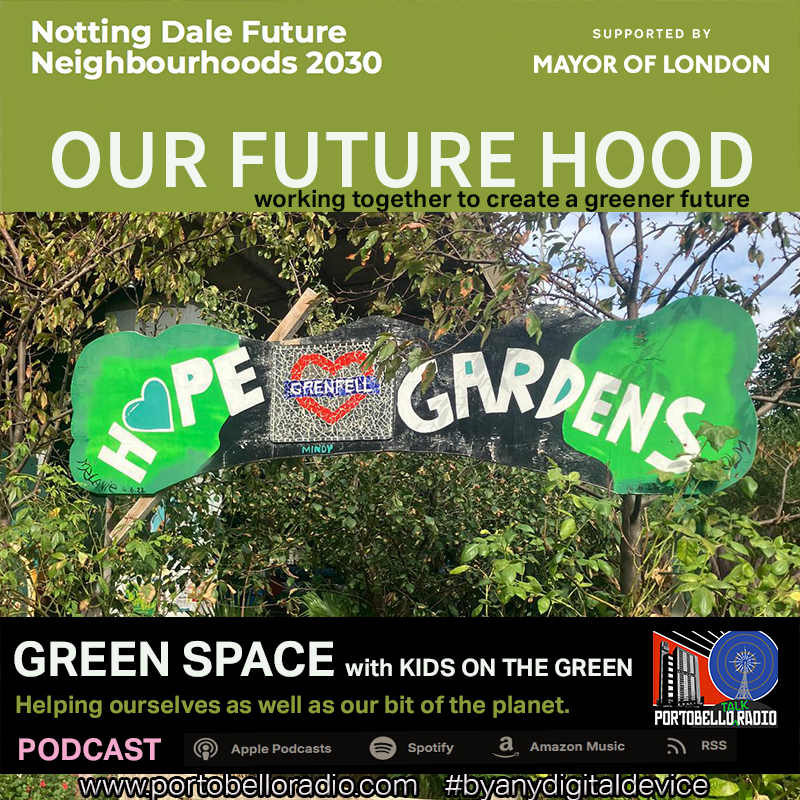
[00:00:57] Speaker E: We're here at Hope Gardens to interview Marcia and. And we apologise for the sound because we are in the middle of a concrete jungle of Nottingdale.
Why are green spaces important in urban areas?
[00:01:11] Speaker H: Because of the lack of green spaces in urban areas is the easy answer to that.
But I suppose the more complicated and realistic reason is that it does clean our air.
It makes a difference to how we actually breathe. It reduces things like asthma and the levels of pollution you suffer under somewhere like the motorway literally reduces days off your life.
So, I mean, how much do you value your life is how much we value green spaces in urban environments.
You know, it can't be valued really.
Anything that's helping us to breathe cleaner air in an urban environment that is surrounded by roads and buildings and motorways, then, as I've said before, anything that can help, if you can plant a tree, if you can green your balcony, you're helping yourself as well as nature and the rest of the world.
[00:02:24] Speaker D: How does the garden make Nottingdale more sustainable and green?
[00:02:28] Speaker H: We're thinking of it in a sustainable way, that it's something the community can continue.
So it's something that provides a legacy.
It's something that will.
We hope that it will always be here and that it will be sustained.
The fact that we're hoping to develop the space and make the garden bigger is another way of it becoming a sustainable business that can actually produce training, work, incomes, a better economy and social value to this side of notting down, which is in desperate need for all of that, you know, for trading spaces, for jobs, for something, you know, just for are aesthetic do you know, and how an Environment looks is how people treat that space.
It's how people feel about that space. We find that with Hope Gardens, the more it's grown, the more it's respected.
So we no longer have to have teams of two and three people just cleaning up rubbish because no one chucks rubbish over there anymore. So it's amazing to see how nature sustains itself and encourages people to sustain it.
As you see with a lot of the don't chop down that tree campaigns nowadays. Do you know, I think everyone's becoming more aware of how much it gives us.
[00:04:10] Speaker G: Marcia, what environmental changes have you seen through Hope Garden or any other green space?
[00:04:14] Speaker H: We've been doing bird watching to count the number of birds we've seen coming. If that's increased. It has. We've got a family of magpies now, family of five.
So that was great to see.
In the summer, the butterflies are crazy in the garden. That's lovely. I love butterflies. The bees, they increase as the flowers open.
We leave a lot of undergrowth to attract them in the early days of summer when there's no food.
So if you leave things like the dandelions to grow and open, that's the bees first food for the whole summer.
So never chop over, never chop down dandelions.
Yeah. So, you know, it is in the animals that you see literally, do you know, the birds, the bees, butterflies, flies, all the micro insects that we can't see because we have little bug hotels that we've got stationed in there, and if you dig them out, then it's quite interesting.
So that's the other way of expanding the garden, is knowing that we'll have a space with microscopes and kids can come and investigate and see more about the biodiversity that Hope Gardens bring, or any garden green space brings to the world.
[00:05:43] Speaker D: How has the garden helped to bring local people together?
[00:05:46] Speaker H: Okay, we have local events.
We also have workshops here of different kinds. So we've recently had mosaic workshops, arts and crafts workshops, We've had carnival costume making workshops.
So the art workshops are particularly interesting when we use nature in art.
So making pictures out of tree leaves and things like that.
So, you know, if we keep interest going, people always come, you know, because I'm not sure, because, you know, like a day like this, we do a workshop outside.
So it's a whole different vibe from being doing a workshop in an enclosed building.
People pass, they see people they haven't seen for years, like your good friends just done, you know, and you find that it becomes that that space where people hear, oh, we're doing a summer fest, you know, and they'll come round and see if there's any plants going or anything like that. We also now started to do a community market.
We found that's a great way of encouraging young people and older people who are doing their little businesses at home to come out, display them, try and sell them. It's a bit like a dragon's den, you know, you may think your ideas like, hey, I'm top of the world with this.
But, you know, when you bring it out to the public, you get to test it to see how people receive it.
So we're finding the community markets really bringing people together like that.
[00:07:37] Speaker F: What are your hopes for the future, especially for young people?
[00:07:41] Speaker H: My hopes for the future for the younger generation is that we're able to train people up who want to be here so that they can move into real paid jobs around the environment, you know, because within an area such as Notting Dale, the idea of earning a living from gardening or anything to do with the environment is pretty off the scale. It's way out there. It's like, oh, that eighth feet me. And we want to change that conception, you know, and introduce our neighborhood children to all the different prospects that working within the environment brings. Especially nowadays where there's huge campaigns, people are becoming famous from it. You know, there's Greta Thornberg and quite a few others I can mention who just started working in the environment and they're mega names now, do you know? And I'd love to think that children of this area are not deprived of those opportunities which they are beyond now.
[00:08:59] Speaker C: How can people get involved with Hope Gardens?
[00:09:02] Speaker H: It's quite easy. You can Visit our website, www.hopegardensw10.org and contact us. Send us an email saying which way you'd like to get involved, if you'd like to do gardening or watering, or you'd just like to come along and help the project. We've got a lot of administration work that we have to do to get permissions and licenses. So there's different people, different ages, different skills that we really need help with, with at Hope Gardens. So please feel happy to get in touch with us.
And now you've seen Hope Gardens, I'd like to know what interests you, what do you think you'd like to do, and any other ideas you've got for our future.
[00:09:58] Speaker G: So I'm quite interested in how you kind of plan around the cycle of the growing plants, because I know some plants have different cycles. For example, some plants will also they'll, like, send out the seeds differently.
Very kind of intrigued by how you deal with some of them, because, for example, I don't think you have any exploding pods, but that'll be quite interesting if you do.
[00:10:23] Speaker H: And that the different seasons is one of the most interesting things about gardening. I think that's why everyone loves spring so much, because you see all the flowers literally opening up, you know, and that is the real result of planting bulbs, etc.
[00:10:42] Speaker F: I think it's really interesting how just being in an open environment helps people's mental health and it improves their quality of life, because living in an urban area, most people don't get access to it and it's really disappointing to see how many people don't have the connection that this area does with plants and being able to see and just be around the environment. So I think it's really useful that Hope Garden has created a space for all different generations to be able to come and just be in touch with nature.
[00:11:16] Speaker H: Thank you. That's really great.
And I hope you take that interest further as you grow older. Do you know, into maybe not the planting of plant might be the scientific levels of plants and being in gardens, etc. And that's exactly what we want, is to open the curiosity of all of you.
[00:11:38] Speaker D: I quite like how it's like an open space which is like, open to the public, just for people to use and, like, share or bond with other people around them. It's a way for the community to connect and, like, reflect on their days or. Yeah, just gives people an opportunity to, like, relax as well.
[00:11:58] Speaker H: Oh, thank you. That is the main aim of Hope Gardens is that people feel there's a space they can relax.
You know, they can be by themselves or they can meet other people, talk to who they see passing, but it is that friendly, open green space.
[00:12:18] Speaker E: Hope Gardens made me feel quite warm inside because it shows how we have a community that's stabilizing everybody and keeping everybody together when times were hard and difficult.
[00:12:34] Speaker H: It's a delight to my heart just to hear the things you're all saying, because those were the aims we had when built.
So thank you all very much for your input and we hope to see you again soon.
[00:12:49] Speaker B: After exploring Hope Gardens, right beneath the Westway, the kids on the green took a trip northwest to an even more ambitious project, Bush Farm near Wembley, founded by Dove.
[00:13:00] Speaker C: Dove, Will you please tell us the story about Bush Farm?
[00:13:04] Speaker A: So I originally came here in 2003, three with my first horse, and it was just the best find in the world.
It saved me from being on the streets and doing silliness and all my, like, it was in a time when all the youth clubs and everything was shutting down and nobody had anywhere to go. So you just end up on the streets. I'd watch my friends turning into people that they weren't well, you know, whether it's like selling drugs or all my friends that would be like, with the fresh white trainers and stuff like that, you wouldn't be able to stand on their shoes normally bring them up to the stables and you'd watch all their layers just drop. All the horrible stuff that they have to deal with every day, whether it's, you know, abusive parents, worrying about money, not liking their school, all of that would just disappear when they came to the stables.
And I just knew from, from then, so I was like about 13, 14, like I really want to be able to provide like a youth area and some sort of with horses and animals.
And that's kind of how it started in my, in my head.
[00:14:26] Speaker G: What do you want to make happen in Bush Farm?
[00:14:29] Speaker A: So the plans for the future of Bush Farm, which we've already started, we had a 400 year old barn that was dated back in the Doomsday book, which fell into dilapidation and we've now knocked it down. We're rebuilding a new barn and not only will it have stables this time, it will have a community space which can be used for this local schools to come and kind of do smaller lessons, whether it's for children that are struggling in their classroom or for them to come and learn about agriculture and all things naturey.
We're going to have a community vegetable garden and sensory garden. So with the sensory garden, you know, all year round, touch, see and smell, we're going to get more animals like donkeys and goats and pigs and all of them will come from rescue centers.
So it's not just people that will get helped from this.
We are going to be doing animal therapy.
So if one.
[00:15:43] Speaker H: Yes.
[00:15:44] Speaker A: People struggling with depression, if you've got educational specialties. Is that what you'd call it? Yeah, which I'll go into the story of that later.
But also people have got like addictions.
So whether it's gambling or alcohol misuse, with addiction, you know, you lose your friends and you lose your family.
Now horses are one of the most incredible animals when it comes to helping humans. They have the biggest hearts for mammals and they will, when they, when they are interested in you and you're focusing on them in the therapy they will actually think their heart to match your heart rate, to make sure that you feel safe. And you don't know it, you can't feel it, but your subconscious, your, your old human self can tap into it. And that's incredible.
[00:16:45] Speaker E: So Dov, what is the variety of species here at the barn?
[00:16:50] Speaker A: So apart from the horses, there are 800 recorded species and that's 21 types of butterfly and over 500 types of plants.
[00:17:03] Speaker E: And how do you know that?
[00:17:05] Speaker A: Because on every Sunday the conservation team, team who kindly volunteer their time, they come here. They've been coming here I think for about 50 years.
And they have another gardens very close in Roe Green park. And they've been recording all the plants and animals and taking care of the whole park.
[00:17:27] Speaker F: Why does every child deserve access to nature?
[00:17:30] Speaker A: I don't believe it's about every child. I think it's every person deserves access to nature.
We, you know, we are natural beings and we are forced to live and coincide in a concrete jungle which is quite demoralizing.
And if more people came and touched grass, I think we'd have a lot more kind people.
[00:17:54] Speaker C: Dove, will you please show us around?
[00:17:57] Speaker A: Yes, I'd love to.
Come on you two.
[00:18:02] Speaker G: Come on.
[00:18:05] Speaker A: And so, because that horse, as I said, he's a cob. So originally he would have been used for farming.
And obviously in the winter and the spring when the ground gets really muddy, you want their skin protected from the mud so the long fur would stop them getting all muddy.
[00:18:30] Speaker G: I have a question. Is that you see that above the hoof is that little ball? His ankles?
[00:18:37] Speaker A: Yes. And it is called a fetlock.
[00:18:41] Speaker G: Do you clean the horses hooves?
[00:18:42] Speaker A: So I pick the horse's hooves out as regularly as possible. But then every six to eight weeks you get a farrier that comes out. My horses don't wear shoes because they live out all the time, they're not in much work, they don't need them. So they basically just get their nails trimmed.
[00:19:02] Speaker E: How do people react to the horses?
[00:19:04] Speaker A: It depends on where I am going down the road.
People are astonished really because they don't expect to see horses in London. One of my favorite things though is we've got lots of schools locally and, and the children that come here after school, they've all got their own names for the horses. And they, and I, I love that, that they can have like six names to people. I don't know. I think that's really special.
This is nothing.
When people complain to me about the cold and I'm here at 4 o' clock in the morning and it's been like minus 10 and I'm there cracking the ice so the waters. Have something to drink. Yeah, Nothing.
[00:19:52] Speaker H: We've all got good luck.
[00:19:53] Speaker A: I'm like, yeah, until you get to winter and you have to be here non stop in the rain and cold. But then when the spring comes, you kind of forget about it and it's all worth it again.
[00:20:06] Speaker G: It's quite windy here.
[00:20:07] Speaker A: Yeah.
[00:20:08] Speaker E: Oh, it's super cool.
[00:20:09] Speaker A: Guys, this is not London, right? This is just like absolutely mind blowing.
I feel like.
They love it.
Where's Wembley? Wembley Arch. You can see it over there.
It's actually only in the last, like two years that there was any other buildings, but they're all coming up now. There used to be nothing.
I mean, they didn't even used to be the arch. So this is one of the ponds. There's quite a few ponds varying in size and they're all full of life.
Mind you, maybe not that one. It was very clay.
But yeah, you have newts, toads, frogs, two ducks and this one. We've got lots of herons here as well and water nymphs.
[00:21:03] Speaker G: I see the tadpoles. I can't see any.
[00:21:06] Speaker E: You have to look very closely, Leandro. Duh.
[00:21:09] Speaker A: Dirty, isn't it?
[00:21:10] Speaker G: Yeah.
[00:21:17] Speaker A: We had a nice mixture of frog and toad spawn here, coinciding.
That was quite cool in dragonflies.
[00:21:29] Speaker G: Why is water important in areas like a bush farm?
[00:21:32] Speaker A: Because it adds extra biodiversity and gives a bigger platform for more types of animals and plants.
And I suppose it helps with water drainage.
It's big.
Over the last few years, watching these ponds, because of climate change, they've always been quite stable until recently. And now they will be bursting their banks or they'll be dry for 10 months at a time, which has never happened before.
So it's quite nice. I don't know how long the water will last. This time last year year it was gone by May. So, yeah, I don't know how much that's impacting things, but. Hence wanting to put another pond and drainage on the bush farm site is to create another safe space for animals and a bit more education.
[00:22:39] Speaker G: They are small.
[00:22:41] Speaker A: I like it when they get their back legs.
[00:22:43] Speaker G: Yeah.
[00:22:47] Speaker C: I think that the ones on the leaves are asleep because they just don't move.
Oh, now they're moving.
They're moving down their little tail. I think that one, that one. I'm gonna call Nemo because Nemo has a bad.
Well, because they're tadpoles, they bad. They aren't that smart. But Nemo has like a broken fin, so. But that one's not moving.
[00:23:18] Speaker A: So many hedgehogs. They're all kind of coming back out of hibernation now. It's warming up and yeah, night time, two o' clock in the morning.
They're everywhere.
[00:23:32] Speaker E: Well, all of these trees.
[00:23:34] Speaker A: And this is the original orchard.
There was once an estate that went with this farm and we have lots of apple trees, mulberry tree, pears, plums, damsons, cherries. And I think my favorite is that we have beehives.
[00:23:57] Speaker G: Do they help the ecosystem?
[00:23:59] Speaker A: Yes, because we have lots of different flowers and fruit. So means birds as well as bugs are eating
[00:24:09] Speaker D: what happens to all the fruit once they're grown.
[00:24:12] Speaker A: So the fruit tends to be in season from about June to September.
And people like to make jam and ice creams and pies and everything really yummy. And obviously the birds and bees enjoy it too.
And when stuff that falls on the floor, it's either biodegrades and also the conservation team work heavily in here to maintain it.
[00:24:42] Speaker F: Who picks all of the fruit?
[00:24:45] Speaker A: I do.
[00:24:46] Speaker H: No,
[00:24:49] Speaker A: anybody can pick it. We like to think that people are really respectful and don't go too crazy, take what you need, don't be greedy and don't feed them to the horses either. The horses get enough treats.
[00:25:06] Speaker C: Thank you for showing us around, Dov.
[00:25:08] Speaker A: You're very welcome. What have you learned from here today and what have you enjoyed?
[00:25:14] Speaker C: I enjoyed seeing the tadpoles and I learnt some of the the closest names.
[00:25:24] Speaker D: I've quite enjoyed just like being around everyone today.
Also like exploring like how like large this land is as well. It's really impressive.
[00:25:35] Speaker F: Yeah, I also agree with that. I think that it's really amazing to have such a big open area within London because most of the area and just in general is just full of concrete. And it's really rare to have such a wide area. They it's just nature.
[00:25:52] Speaker E: I think that it's spectacular that there is such spaces as this as it allows people who just live in the city to roam free.
[00:26:04] Speaker G: I think we have gathered something very important today.
So determination is key and if something doesn't go your way, fake it till you make it.
I really like the hill.
[00:26:19] Speaker A: That is a hundred percent spot on. That has made me so happy. Yeah. Never ever give up.
It would be diabolical if we ever lost this place. And I think without people like us, the council would be so happy to build more flats on it as they have tried to do in the past and back in the 60s, the community got together and protest and they won. And we will keep fighting for this park.
What are you going to take back with you to Labrador Grove?
[00:26:58] Speaker G: I'm going to take back the idea that there should be more green spaces, for example. This is a very calming and relaxing experience and I just felt very nice in general. So I should take back the idea that we need more green spaces because Lab Grove, actually, when you think about it, there's a lot of really stressy people. Like, when you go on the high, like when you go anywhere in Levitt Grove, you see loads of people just rushing.
[00:27:19] Speaker C: Yeah.
[00:27:19] Speaker G: So just be calmer.
[00:27:22] Speaker E: I think I will take back that not everything is, like, so peaceful and it's nice to have. Have like a reminder about during stressful times that there is places to go that are, like, very calming and reassuring.
[00:27:41] Speaker F: Yeah. I think that I would take back that.
You need to have some time to just relax and be calm within all of the stress that goes around. Just living within such a busy area that you need to just take a step back and just go somewhere that you can relax.
[00:28:01] Speaker D: I'm gonna take back, like, I need to appreciate, like, more open green spaces because it's very rare within London to actually find untouched areas.
[00:28:10] Speaker A: This makes me really happy to hear. And, yeah, it is the last organic space left. And you're completely right about time. I say, when we're here, time doesn't exist. It is a vortex into peace and taking in the moment rather than going, what have I got to do next? What's for dinner? Where am I gonna miss my bus? Da da da da. The other hundred horrible things.
So, yeah, thank you guys for coming and I'm really glad you enjoyed it.
[00:28:38] Speaker H: Brilliant.
[00:28:42] Speaker B: Thanks for listening.
My name is Zakiya. This is Portobello Radio, your local community radio station. All episodes of our future hood are available wherever you get your podcasts.
This series has been supported by the Mayor of London, Portobello Balloon.