Episode Transcript
[00:00:02] Speaker A: You are listening to Portobello Talk Radio, the authentic voice of Letbrook Grove.
[00:00:10] Speaker B: Hello and welcome. My name is Akiya and I'll be your host for season two of our Futurehood. It's a series of podcasts set in Nottingdale about how we can work together to create a greener future as part of the Mayor of London's Future Neighbourhoods 2030 program.
In the process, we'll be helping ourselves as well as Albert of the Planet.
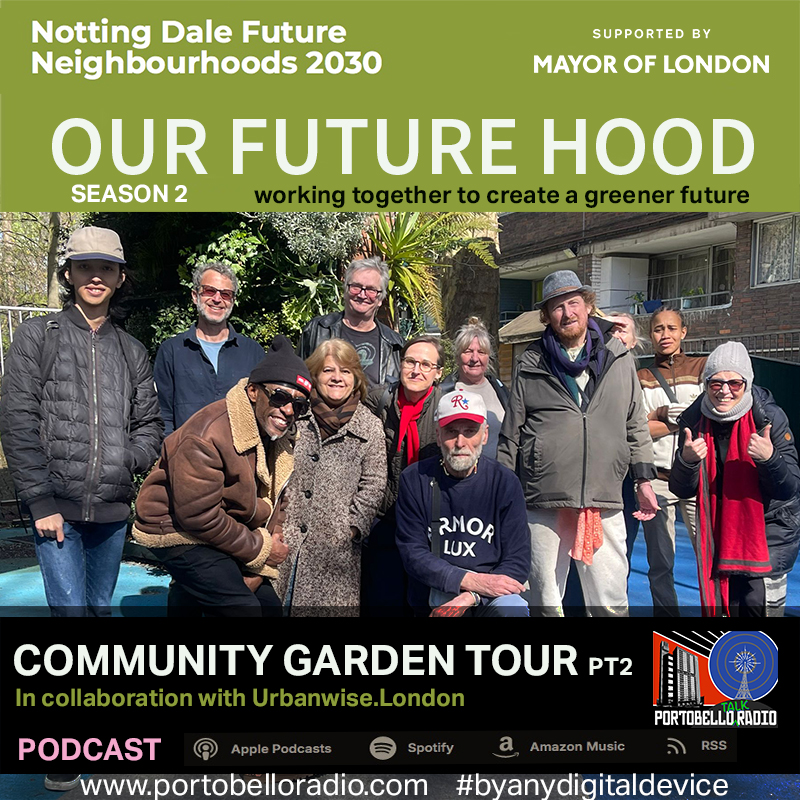
In this series, we are working closely with local community groups and in this episode we went on a community garden tour of Nottingdale with Urbanwise London. In the last episode, we visited the secret energy garden at Labragrove Station and the Museum of Brands. Let's pick up the story there on Lancaster Road.
So, Robert, can you just tell us where we are?
[00:00:56] Speaker C: Lancaster West Estate. And we are in Verity Close at the Verity Garden.
And that is a sway.
I love these. You learn these things. A sway. A sway is a bridge and underneath a sort of.
Lisa Wilkerson. You probably could tell me more about sways.
[00:01:12] Speaker A: Well, they're sort of like drainage and slow drainage places to go and they give a good place for wildlife to hide and have habitats really with them.
[00:01:24] Speaker C: Place to have a group photograph. Right. Flood resilience is a problem everywhere, isn't it? And so a sway is one thing, but you talk about the rain garden down there.
We have a strange climate in the world, don't we? So we have to consider that. I mean, you know, we keep bringing on to really so Wilkinson. So everything we plant now and the way we go forward, we got to consider climate change, haven't we?
[00:01:48] Speaker A: I mean, climate change is very important, but also the weather is.
Likes to be very confusing. As you can see, we're in a bit of a chill after sort of 18, 20 degrees, when I thought I'd get everything in my greenhouse going and then I've got to rush in and put them all into nice cozy blankets to get them through the thing. So whatever you plant will either survive or it won't. It will adapt or it won't. But you have to be a bit considerate about what you're putting in. With the amount of water, the amount of building that we've done in inappropriate places has caused a lot of our, you know, we're causing a lot of our flooding problems ourselves because we're not allowing slow drainage, we're building on floodplains, we're doing all sorts of things and cities are absolutely guaranteed. They're forcing an awful lot of Water at an awful lot, very fast rate into the Victorian drainage system. That's not suitable. So by having sways, by having, you'll see around the borough where they planted along the edges of the pavements. So this is all to do about slowing down the amount of water that's entering. It's not the quantity, it's the speed at which it's entering the system. That's really what it is. So take into consideration if you can plant to absorb water and to slow down that, you know, we're paving over our front gardens to make places for parking cars. And then. So where's that water going that's landing on it? You know, plant a garden plant, so you've got it going through the soil. That's going to take time to go. That's important stuff to do. I could go on forever.
[00:03:27] Speaker D: So, you know, Notting Dell, the area of the future neighborhoods is actually an area of high flood risk because there's a river going on on the ground, one of the London Ross rivers.
So about 10 years ago, over 300, we had a big flooding in the area. Three schools got flooded, over 300 residents were affected. It cost over a million pounds in the local area. So it's very disruptive flooding. And as Lisa is saying, one of the reasons we get flooding is because people keep paving things, putting hard surfaces, so when we have these extreme rain events, the water has no way to go and then we get flooded. So we're kind of trying to encourage people everywhere, particularly in the future neighborhood, not in Deleria, to put measures to absorb water, slow the water down. And there's an initiative at the moment that can give free garden measures to local residents, called My Rainwater, that people can actually access and see how they can help locally.
[00:04:34] Speaker C: And I think a lot of residents, a lot of locals don't know this and I think what you both said and what we're all saying here is this needs to be explained to people because people will then blame the council and blame. But you know, it's flooding, what's happening.
And you put it, you know how you both put it. So it's a problem.
[00:04:54] Speaker D: Yeah, it's a problem.
But we can work together to solve this issue. That's one of the reasons we're doing this work, to raise awareness of what's happening in the local area, how people can get involved, what else can they do?
If they have a little garden or even they have a flat and have an outside area, they might be able to put a planter that solves Rainwater and then we slow the water down, avoid flooding. But also people can access. Help access gardening, get access to nature.
[00:05:23] Speaker A: Yeah, it could be a solvable issue.
[00:05:29] Speaker B: So we've just arrived at the Henry Dickens Community Kitchen garden and so we're here with Lisa, who's going to explain more about the space and how it came into fruition. And just wanted to ask, is this space considered part of the Henry Dickens estate?
[00:05:43] Speaker A: The space is owned by the Henry Dickens Housing, but it is open to locals that live within the vicinity. You're not going to get a space here if you live in Chelsea or anything like that. So you have to be very local to have a space here. Ideally, you're coming from the estates.
So this is part of the council's kitchen garden scheme that was first conceived in about 2009 and was started to be installed in empty spaces from about 2010.
This one went in from memory about 2013, 2014.
And what we did as a team, as the local authority, we looked at spaces that were not built being well used.
There was a big push for people wanting to grow food, but not enough allotments. There's a whole thing around allotments which I can tell you. We can do a whole program about allotments and what they mean and what they are and what they signify. But these are small, manageable beds, generally, generally about 2 meters by 1 meter. They're not exact across the whole borough. It depends on what we've designed and what we haven't got.
And it's been working really, really well. This garden works extremely well. As you walk around, you'll see all of the borders and everything which are maintained by the plot holders. They love it. And this is like a perfect accumulation of all the hard work, because the residents have taken the ownership of the garden and we're just here to help and support them.
There are certain rules and regulations for having a space in the kitchen garden, because we have to make it work for everybody, not just the individ, and we have to think about the longevity of the project.
So you can't plant an apple tree, even if that's your passion, because it's not a big enough space, and then it takes that space out of use for other people. If we say no to something, we will always have a reason why there's a no to it.
We don't want to say no, but there we go.
Some of the plots are better than others because we can't decide exactly where we've been given the space. So even in this garden, some are more sunny, some are less sunny, but then just decide what you're growing.
So you might want more shade loving plants. It is a food growing project rather than a flower growing project. But where we can, in external spaces, you can grow the flowers. Herbs. We try to have communal spaces for herbs so you can share them because they take up a lot of room in your beds and you can't. You can, if you plan very well, have a really good amount of produce from one of these. And it takes, you know, maybe a couple of hours a week through the growing season. It's not onerous, but it does take some form of commitment.
This one is very interesting because we've originally always built our raised beds in wood.
But the wood quality as we're getting on and it's being more forced grown, so they're growing pine like it's your local plant in your kitchen. It's force grown so it's not as dense, so it doesn't last as long.
And then also there is a huge demand on wood and we were finding that we're having to replace where they were lasting 10 or 12 years, they're now lasting maybe five or six. The spirit, especially with the really wet winters, nothing's drying out properly and wood, if it doesn't really dry out, then starts to rot from the inside and then all your lovely insects, which we really want to encourage to suddenly find a home and start munching away on more. So these are now, we've just had this one this year rebuilt with recycled plastic sleepers.
So they seem to be very good product. We did do some research on it to see what it is.
It's a bit more pricey to start with, but they're supposed to have a 50 year lifespan and if it isn't quite 50 years, I won't be around to know that.
So that's, that's a bonus with it all. So this is new. I quite like the fact, the color contrast, I don't think it looks like, oh God, that's ugly, that's plastic. So I think it's still quite in keeping. It's still neat and there's still, you know, it still keeps it looking good. If we'd like to walk around, we can have a look at some of
[00:10:05] Speaker B: the spaces and also maybe you could tell us some of the herbs or the veggies.
[00:10:10] Speaker A: That hasn't been in use for a while. So you've got a lot of nettles and things coming into it.
[00:10:19] Speaker B: Sorry, Lisa, could you use those nettles for nettle tea.
[00:10:22] Speaker A: Absolutely. You can use it for nettle tea. It's also very good in your compost. Nettles are very strong. There's a lot of old wives tales around it about what it's good for, what it's. What it's not good. As you saw Robert just rubbing his wrists on it. That stimulates your. Because it stings. Stimulates your body to produce antibodies. So if you've got arthritis, they reckon it helps with arthritis.
[00:10:45] Speaker B: That's really interesting to know.
[00:10:46] Speaker A: I'm not recommending anything but also I
[00:10:50] Speaker B: would say if anyone is interested in anything said, please do your own research and just double check that it's good for your body and healthy.
[00:10:56] Speaker A: I mean, we mentioned something like St. John's words wart. That is a smoking thing. Yeah.
[00:11:01] Speaker B: That people can use to help with their dreams or if they're trying to cut back on smoking.
[00:11:04] Speaker A: Yeah. There's all sorts of things. But St. John's Wort is used for antidepressant things. But it also has a very powerful thing which interferes with other medications. There's some herbs which kind of clash with. So if you're on any prescribed medication, please, please, please double check any herbs that you might be using. Just because their herbs doesn't automatically mean they're completely safe. Most of them are. I don't want to frighten you, but do double check broad beans, which were probably planted in late December. Coming up, somebody prepping their plot. And again, that's chard, which will go through the winter.
[00:11:44] Speaker B: Nice.
[00:11:44] Speaker A: So we've had. It's been quite cold. So look, quite a few people haven't started to get back into the garden. Smile nicely.
[00:11:52] Speaker B: So with these plant beds with the kind of gardeners that use them, is there a waiting list for people that
[00:12:00] Speaker A: are in waiting lists across the whole borough? So you make an application for a space, your name goes down. We use your postcode to allocate you to the closest garden. Now, some people's got. Some gardens are much more up and running like this one, and others aren't. So people go, why can't I be in that garden? Which, you know, this garden was like that.
[00:12:19] Speaker B: Yeah.
[00:12:19] Speaker A: You know, if you want your garden to look like this, put the work in, we will support you.
[00:12:25] Speaker B: Yeah. No lies told. It's true. You can't just expect everything being given to you. You have to put in the effort and you'll see kind of. Yeah. Your. Your work in fruition here.
[00:12:34] Speaker A: And if you have a look, they've done all of These wonderful fruit trees. So this is not us installing. These are the people with up. You know, they could, they say, all right, if we do that and you know, as long as there's not a reason to say no, go ahead and do it.
But you know, if you're planting trees, everyone wants more trees, more trees. Who's looking after them, who's maintaining them? What's the long term?
Yeah, there's a lot, there's a lot of work going on. So there's fruit bushes all along here and then you've got all your lovely pollinators coming up, got a lovely gardener, then some more fruit trees. Baby pond, little baby pond. We have an absolute pond. Mad lady, which is fantastic. And as you have a look here, there's a small pond. So this wildlife pond. Can you see that? They very carefully kept a branch coming in and out.
[00:13:23] Speaker B: Yeah.
[00:13:24] Speaker A: If you put any pond in, you've got to be able to have access. So for frogs, for amphibians and, and anything that needs to be able to come out of the pond, it's also got a cover over it, so, so it's safe for small people and they're not going to jump in it. That's just that, that, that's a kind of overflow from the big wildlife one. Oh, there's another one.
They're in the middle of letting it drain out a little bit and clean it and tidy it all up. So this has got all the ferns and all the bits. So you, when you make a pond, you don't want it to be like a perfect little area. It's got to have a nice little bit of debris around, nice little places to hide in the winter when the frogs come or the toads come and all the other things. So if we're very quiet, you'll see little flicks on the water and that'll be sort of a water boatman. But they've just having a big tidy up and a clean in here. It's not looking its best.
[00:14:19] Speaker B: Yeah, I was going to say this was like a skull's head or something.
[00:14:21] Speaker A: No, it's, it's. But this is what happens. Yeah, nice bit of beauty. So all of this came about when they got some supports and we started off, or they started off with a built in pond. Now you might recognize this more as a sort of pond, pond, garden pond. This is a fish pond and it's, you know, they tried to work very hard to have it solar powered but that just wasn't enough sunlight. And then it was coming up, they did find themselves with an awful lot of fish because people, when their fish overgrow or they become too many, they were sneaking them in here, which is never a good thing. That happens. Happens quite a lot.
But fish generally grow to the size of the space they have.
So, you know, there's plants and things there.
[00:15:15] Speaker D: So we're.
[00:15:16] Speaker A: We're encouraging everything. So they started off with this and then they got very excited about having a more natural pond. And then they. It's not big enough, but we're not going to dig out the whole area.
The other really interesting thing with this garden is there's a big thing about food waste.
[00:15:33] Speaker C: Do they have no problem with birds getting in here or. No, not at all.
[00:15:38] Speaker E: Cool.
[00:15:38] Speaker A: There is actually normally more coverage over there. So they are. That, you know, it's encased and then gets opened. So in here, this is all their area for the gardens at the back of the. Every good garden needs really good composting, really good recycling of materials and why things grow so well. So this.
People sometimes don't want to put it on their plots because it doesn't look beautiful, like it comes out of a bag. But this is all go around all of the communal areas.
So they have here, not only can you chop up all your garden waste and pop it in there, they do something called bokashi.
[00:16:17] Speaker B: What's bokashi is a ring.
[00:16:19] Speaker A: So bokashi is a composting system which is anaerobic. So it means it's done without air.
[00:16:25] Speaker B: Okay.
[00:16:26] Speaker A: So it's done through microbes. So you can do your food and you can do all your food waste. So because it's a small garden, we allow them to bring their food waste here, which has to be vegetables.
With bokashi in general, you can. You can put any food waste in it, but we don't advise it because I don't really want somebody putting a pork chop in there and then somebody complaining because it's against their religious beliefs. So. And also meat can take. It can get a bit smelly and a bit horrible and, you know, it will have eventually rot down. And it is very usable.
It produces a juice which some people drink. I haven't quite. I brought myself to be able to do it.
[00:17:04] Speaker B: I don't know if I could do that.
[00:17:06] Speaker A: Yeah, yeah, the juice. So. So it's called every compost. Every compost will produce something called lechate, which is excess liquid, which is like supernova for your garden. You can just water it down. But for some reason, I have no idea, it's Absolutely has this. These all have to be airtight. How good are my hands to be?
So can you have a look in?
[00:17:30] Speaker F: Yeah.
[00:17:30] Speaker B: I cannot drink that.
[00:17:31] Speaker E: Boy.
[00:17:32] Speaker A: So this is all. So this is all the stuff in there and it's covered with a mash, which is kind of like a sugar and sawdust mash and that brings it on. So you have one bin which is.
Make sure it's always air tight. They'll kill me. So when that bin is full, they'll start using this bin. When this bin is full, that one will get empty into the compost area and get used. So this garden is really brilliant for recycling and everything, but this has only happened slowly and working together with the residents and people coming in and wanting to take on, we've got to think, boring, boring, boring. What's going to happen when that really passionate person either loses their passion and moves home, has enough? We've got to have somebody coming up behind to help and support. And luckily that's what we're building here and they're building here.
This is the history of Henry Dickens and this is what's possible if you work together with your residents.
[00:18:39] Speaker B: So on our walk down to Henry Dickens Estate, we've passed Verity Close Rain Collection and we passed a nice little community garden. And now we're just walking past St Clement's St James Centre, where Lisa is telling us about the garden that they set up just after Grenfell's arrest bite location for local residents dealing with trauma and everything related to the Grenfell fire.
[00:19:05] Speaker A: So, yeah, so this garden's really interesting. We rebuilt it and it was a lot of people coming along, but it's now been changed over and they're now getting another. A new gardener in, you say? Starting in April?
Early April. So it'd be quite interesting to see. But I will just point out this is a mulberry bush.
[00:19:24] Speaker B: Okay.
[00:19:25] Speaker A: So whenever you're singing your song, round and round, the mulberry bush. This is a mulberry bush. It's supposed to be a miniature, but I think it might have decided it's a bit big, but it has the most delicious mulberries. And as the gardens open and if you want to pop past, if you've never tasted a mulberry, it's well worth the doing. But you can see there was food growing here.
Beautiful different plants coming along. So I'm hoping to see it come back to its full fruition very, very soon. So just a quick pass by.
[00:19:56] Speaker B: Thank you.
[00:19:57] Speaker E: Is that an olive tree?
[00:19:58] Speaker A: That's an Olive tree.
[00:20:00] Speaker D: Can I say something extracurricular as well? Yes, which is that actually I.
A couple of years ago I joined Pike Nectar Steel Band who are actually based in St. Clement's Church. And we won last year best band on the road on Sunday.
And we welcome. If anybody here is interested in participating in Notting Hill Carnival and having the best community experience, please join us. We're going to start rehearsing soon. You can actually see under the tarpaul there, that's our manual push float. We are the last band who still actually walk and play at the same time.
And we're not on top of a big truck with a lot of pollution and sponsors. We're actually very community based, a lot of trinitarian and diverse people. So if you want to find out, ask me. But we rehearse on Sundays evening starting probably in May, so.
[00:20:59] Speaker B: Brilliant.
Okay, so now we are off, final stop at the Lancast Lancaster West Estate Tea Garden. And we are here with Rob. Rob who is going to explain the garden and give us a little tour and so please stay tuned.
[00:21:17] Speaker C: Yeah, well, I mean my life changed after the elephant in the room, which is behind us, marriage ended. What am I doing with my life? And I just suddenly, because I was in. It's so important for you to say this. When I was 8 years old at avoiding school, I was in a fire, right. And I get quite emotional saying it. And Parker died in the fire, he didn't get out. And I built him a little rockery and I got a little award at school and I didn't tell any about this. And when this happened, the smoke came back to me and I went, I want a garden for Parker who never had a chance to be heartbroken or.
So I started gardening for him and then for everyone else as a volunteer.
And I kept turning up and I said, this is an empty space, give it to me. So I created a garden here. So if you come in here, I know they're rustling the bags. So you come in here.
The first thing I always do is rub the rosemary.
Because as we get older, by the way, we lose our sense of smell. Perfumia is like athletes, they work on their sense of smell. We live in a society in England where you can't smell.
You know, you go to like Italy, you can smell the tomatoes, you go to Morocco, you can smell the mint. You can. Whereas somehow in elbow cities we have taken away that whole sense of. So I suggest to all of you, like athletes, smell the rosemary. It's the plant of remembrance in Hamilton So come in here. This is soil. Obviously, I have little bags here.
[00:22:52] Speaker B: So tell us, so tell us about the garden. Like, what are we looking at? Different plants.
[00:22:55] Speaker C: Okay. Well, the bottom of, of a tree is often a neglected area. So you have some, you know, you have a few spring flowers, you have some mint. So the bottom of the tree and around the place you have things. There's sage if you want some sage. So we have bags here, right? So you come as a resident, you take a bag.
Russell, Russell of the radio.
You have a bag and then you go.
You live upstairs. You go, oh, Robert's coming for dinner. I need some rosemary. You don't have to go to Co op. I believe wherever you are in London, you should be able to forage and get certainly mint, certainly sage, certainly thyme.
So, as I say, this is one of many gardens do enter.
The garden has a green roof, which are. They're important. Lisa Wilkinson, how important are green roofs?
[00:23:49] Speaker A: Very important. They help keep building cool. They help keep a building cool. They're very good also to absorb the rain that we talked about earlier.
And, you know, just in general, they're pretty. They're great for wildlife. Generally, it's a small. You have to check the weight that is possible to put on a roof. And it's generally things like sedums that you will find on the roof. You're not going to plant your rose garden up there.
[00:24:14] Speaker C: And I have here loads of mint. You see, I've grown a load of mint and I've cut some. And you're all welcome to take a bit of mint home.
Rustle your bags.
So the tea garden, as I say
[00:24:30] Speaker B: now,
[00:24:33] Speaker C: we have a. We had scaffolding there for two years. That's come down. The lavender garden. You know, there are some empty trucks here because I have to keep moving things around, which is not easy. There's water butts. There's a really good one around there. Water butts. But while we're here, right, I'd like to. Where's Tirzah?
Have I said the name right?
Thurza yesterday did a workshop of spider plants. And I want to show you the spider plants we. From one spider plant, you created 50 spider plant babies. And around the corner there, there are some spider plants around there. Have a look.
[00:25:10] Speaker B: And for those that are listening, can you tell us what a spider plant is and what it's good for?
[00:25:16] Speaker F: A spider plant is a house plant that is really good for keeping the air clear in the home. So it's fantastic for your health and benefits and They're a joy because they're quite easy to grow.
Don't grow them in the direct sunlight, preferably, but they love light.
But just have it, you know, a little bit back from the, from the sunny windowsill and yeah, very easy to grow. And they, they, they're not called spider plants because spiders love them. They are called spider plants because they look a little bit like a spider spider. The way the leaves, the long leaves hang down and then the babies grow off the spider plant. So they hang down off a stem and then you'll get the little babies at the end which you can then cut off and you can actually plant them straight away. But I tend to like to pop them in water, grow on the roots a bit and then I can put them in soil.
So, yeah, yesterday I brought, yeah, nearly 50 little babies and we. And with a volunteer group, we potted them up together.
[00:26:30] Speaker B: Lovely. Well, I can't wait to see them. Let's go over there.
[00:26:34] Speaker C: Piers, you know me a long time, I do get over excited, so.
[00:26:41] Speaker F: Oh, the reason, because I.
[00:26:43] Speaker C: Because I really believe in what we're doing and I think this walk's been so important for everybody and we've got to get more people involved.
[00:26:51] Speaker B: Well, I was actually just about to ask you, Robert, what makes this tea room so special to you?
[00:26:58] Speaker C: It's special to me because when I got my council accommodation in 96, I was very, very grateful and I think it comes out of gratitude and also because as peers know me, I'm a very speedy, highly energized. Imagine me young. It was a nightmare for anyone. And so there are places weird me saying this because obviously now I'm a bit nervy because I'm talking on the camera.
It's for my mental health.
It's my mental health and when I see people come and change through being, you know, we're in the middle of an urban environment, stone jungle, and yet we are. You shut your eyes. We are in the forest.
And so I'm doing it for selfish reasons that I'd like to share.
[00:27:48] Speaker A: I love that.
[00:27:49] Speaker B: I really do love that and thank you for being selfish and sharing.
So what kind of volunteers come to this space and help out?
[00:27:56] Speaker C: Right, so for instance, Kaylock, who comes this afternoon, is passionate about litter picking, so he comes every week and litter picks. Then we have a Joe who comes twice a week that particularly likes walking, watering. So he goes around and he waters. We have a group from the volunteer center, Ava, who come every a week. Are they complex needs? Is that what's the right word to say.
[00:28:19] Speaker A: Yes, I would say.
[00:28:21] Speaker E: Yeah, yeah.
[00:28:21] Speaker C: I've never met any human being that's not got complex needs, by the way. Right.
[00:28:26] Speaker A: They are part of our well being group run by my colleague Jaya.
[00:28:31] Speaker C: Yeah. And then we have corporate groups. So for instance, the corporate would be someone like I think, who's coming in the summer. Oriel. Most companies have corporate days where you can have a day off and volunteer.
Octopus Energy have come here and all sorts of. So you have corporate groups, so you get a lot more work done. Then we have a company called Earnt. It's quite interesting, Ernst.
You volunteer but you get rewarded. So it's like if you do 20 hours, you'll get a free.
They work with influencers, so you have a couple of them. And time givers who work with kids. So we have kids groups. We had two last week. So individuals groups.
Can I say the volunteer center has been amazing. So I'd like. I mean, I don't know, Ava, I'd like to say how important the volunteer centre is to our community and community champions, of which I am one.
[00:29:23] Speaker A: Yes, absolutely.
Robert is a community champion.
[00:29:27] Speaker C: Yeah. And I think what you're doing today is sometimes, you know, we're all so busy, we work in isolation in our little worlds and the more we can, you know, I need to go to the energy garden and you know, not to talk the talk. Go there. Come on, Robert. Wednesday afternoon, once a month, go there. I need to go to all the places you've taken me. And I think we all need to reach out to each other just like the bumblebees are doing right now.
[00:29:53] Speaker A: Oh, I love that.
[00:29:55] Speaker B: Yeah, I mean, I definitely agree. I think spaces like this are very therapeutic. Like every time I've gardened, personally, I've just felt so much happier and lighter and I think in light of everything that we've experienced in this area, not just the past 10 years, but the history in itself, I think we deserve green spaces. We need spaces that we can relieve our tension and meet new people. And especially where we're in a time where so many people feel isolated. Why don't we have more spaces like this? Because your friend would love this garden and I think everything you've done to honor his memory is such a beautiful memory.
[00:30:28] Speaker C: And everyone else. And so there, you know, they're tears of joy as well, you know. So, you know.
Yeah, so I'm mumbling now because I.
Because the sun's shining right in my face is. And it's just a wonderful crowd and thank you so much, sir.
So I just think we need to not. It's not just about coming to garden, it's about hanging out. Lisa Wilkes, isn't it? It's not just about, oh, you have here. You've got to weed, you've got to sow. It's also about
[00:30:59] Speaker A: mindfulness.
[00:31:01] Speaker C: Yeah.
[00:31:02] Speaker A: Do a bit of mindfulness gardening. You can be mindful as you weed. You can notice how a leaf looks or how a plant is shaping up. Just step back and look at it. Don't just see what it is, just really look at the shape of the leaf, the feel of it. Is it a spiny texture? Is it a smooth texture? Is it large, is it big? And the noises some plants make. You can be in the garden. You've got bamboo here. So when the wind goes through the bamboo, just take a moment, breathe in, breathe out, and then carry on your door. But just do it in a mindful way.
We don't always do it as gardeners. We're in there. I've got to weed, I've got to mulch, I've got to do this, I've got to chop that, I've got to do that. But you know, it's always worth. When you get a moment, step back and just enjoy what you in front of you and take it slowly. Ain't nobody on your shoulder looking over.
[00:31:55] Speaker E: I think it's very spiritual for me to be around nature and being the garden or what. Not only just working and volunteering as I do here, but I just feel when I'm really feeling disconnected with the world or I'm just feeling depressed, I just go out to a park and Avondale park or Holland Park, Kensington Gardens, and then suddenly I'm connecting to the world and I'm just walking alone, not speaking to a soul, but I just feel part of the world. I don't feel sad, I don't feel depressed. I just feel, wow, look at this beautiful life. Look at this beautiful earth that's given it to me and to billions of others.
And I'm feeling depressed. Well, I'm not because I'm walking in a beautiful place. I feel like in paradise. And that gives me full of life. And then I feel like I want to really interact with people. After a beautiful walk alone in the park for one or two hours, then I feel I am part of the world. I'm not alone.
It's amazing, you know, everyone should do it when they feel loved. Just have a walk, just go to work out.
[00:33:15] Speaker B: That was beautiful. I think you're right. I think we need to kind of log off our phones a little bit more and touch into touch grass again. Literally touch grass.
You know, feel nature. I think we are in a concrete jungle. We're surrounded by blocks and unnatural things, and we need to find the nature in this place that we live in, to put it nicely.
Thanks for listening. Make a point of visiting some of the secret and not so secret gardens in the area.
And watch out for our other collabs with Kids on the Green Nova, Youth Voices and the Kensington and Chelsea Youth Council.
My name is Zakiya. This is Portobello Radio, your local community radio station. All episodes of our future hood are available wherever you get your podcasts. This series has been supported by the Mayor of London.
[00:34:08] Speaker A: You are listening to Portobello Talk Radio, the authentic voice of Letborough Grove.